Advanced mortgage strategies from a twenty-year strategist. Written to help you pay off sooner, save more, and retire three to four times wealthier — without paying more each month.
7 household costs rising because of Trump's 50% tariffs on Canada, and how to cut them now
You have three weeks. August 19 marks the day 50% tariffs hit Canadian goods crossing south, and your grocery bill, mortgage rate, and gas tank are already on the list. Here's what actually costs more and what you can do before the clock runs out.
1. Groceries, especially produce, dairy, and meat
Buy Canadian now, then keep doing it. The US sources roughly 60% of Canada's fresh produce imports during winter months. When retaliatory tariffs land on American apples, lettuce, and berries, the price premium on imports becomes prohibitive. Switch to domestic brands before August 19. Lactantia, Gay Lea, and Maple Leaf are all Canadian-owned. For produce, look for country-of-origin labels, Ontario greenhouse tomatoes and BC blueberries cost the same or less year-round once the tariff kicks in.
2. Gas and heating oil
Fill your tank on August 18. Then ride it out. Canada exports oil to the US, but refined gasoline flows both ways. Tariffs disrupt cross-border refinery logistics, which historically spikes prices at the pump by 8-12 cents per litre within 60 days. A single pre-tariff fill saves you $6-9 on a 60-litre tank. For home heating oil, if you have the storage and use oil heat, top up your tank in early August. Prices lag the tariff date by two to three weeks, but once they move, they stay elevated.
3. Cars and auto parts
If you're buying, close before August 19. If you're not, skip the dealer for a year. Automotive supply chains cross the border five or six times during assembly. A 50% tariff compounds. The average new vehicle sold in Canada contains $8,000-12,000 in US-sourced components. Dealers will pass that through as a price hike or a "market adjustment fee" starting in September. Used cars spike next because new inventory dries up. If you're midway through negotiations, speed it up. If you're not actively shopping, your 2019 Civic just became worth more. Keep it.
4. Electronics and appliances
Order anything big by August 10. Laptops, TVs, fridges, and washing machines are overwhelmingly US-assembled or US-imported. A $1,200 laptop becomes $1,400-1,500 once retailers restock post-tariff. Best Buy, Costco, and Amazon.ca all restock on 30-45 day cycles. Anything you order now arrives pre-tariff. Anything you order in September does not. If your fridge or stove is marginal, replace it in the next two weeks. Waiting until October costs you $300-600.
5. Your mortgage rate (indirectly)
Lock in a rate hold if you're renewing in the next six months. Tariffs are inflationary. The Bank of Canada has already flagged them as an "upside risk" to the 2.5% inflation target. If inflation stays elevated, the overnight rate stays at 4.25% or climbs instead of dropping to 3.75% by year-end as markets priced in June. For a $400,000 mortgage renewing from 2.8% to 4.5%, that's an extra $520/month. Most lenders let you lock a rate 120 days out. If your renewal falls between now and February 2027, lock it this week. Rates only move one direction if this tariff holds.
6. Clothing and footwear
Stock up on basics. Skip luxury. US-made jeans, sneakers, and outerwear get hit immediately. Levi's, Nike, and Patagonia all manufacture south of the border. A $90 pair of Nikes becomes $115-120 by fall. Canadian Tire, Marks, and Costco source more from Asia and dodge the worst, but even their prices climb as competitors raise floors. Buy your kids' back-to-school wardrobe now. Adults: two pairs of winter boots, a good coat, four pairs of jeans. You'll wear them anyway.
7. Alcohol, especially bourbon, wine, and craft beer
Buy American bottles this month. After August, drink Canadian. Bourbon, California wine, and US craft beer are political retaliation targets every single time. Canada's 2018 response included 10% tariffs on Kentucky bourbon. Expect the same or worse. A $50 bottle of Blanton's becomes $60-65 once Ottawa's counter-tariffs post. Stock your bar now if you care. After that, Quebec wine, BC spirits, and Ontario craft beer all gain share because the import premium becomes unworkable.
The pattern is consistent: anything crossing the border more than once in production gets hit hardest. Anything with a US-only supply chain becomes unaffordable. Your move is simple. Buy now if you need it in the next year. Switch to domestic alternatives when you restock.


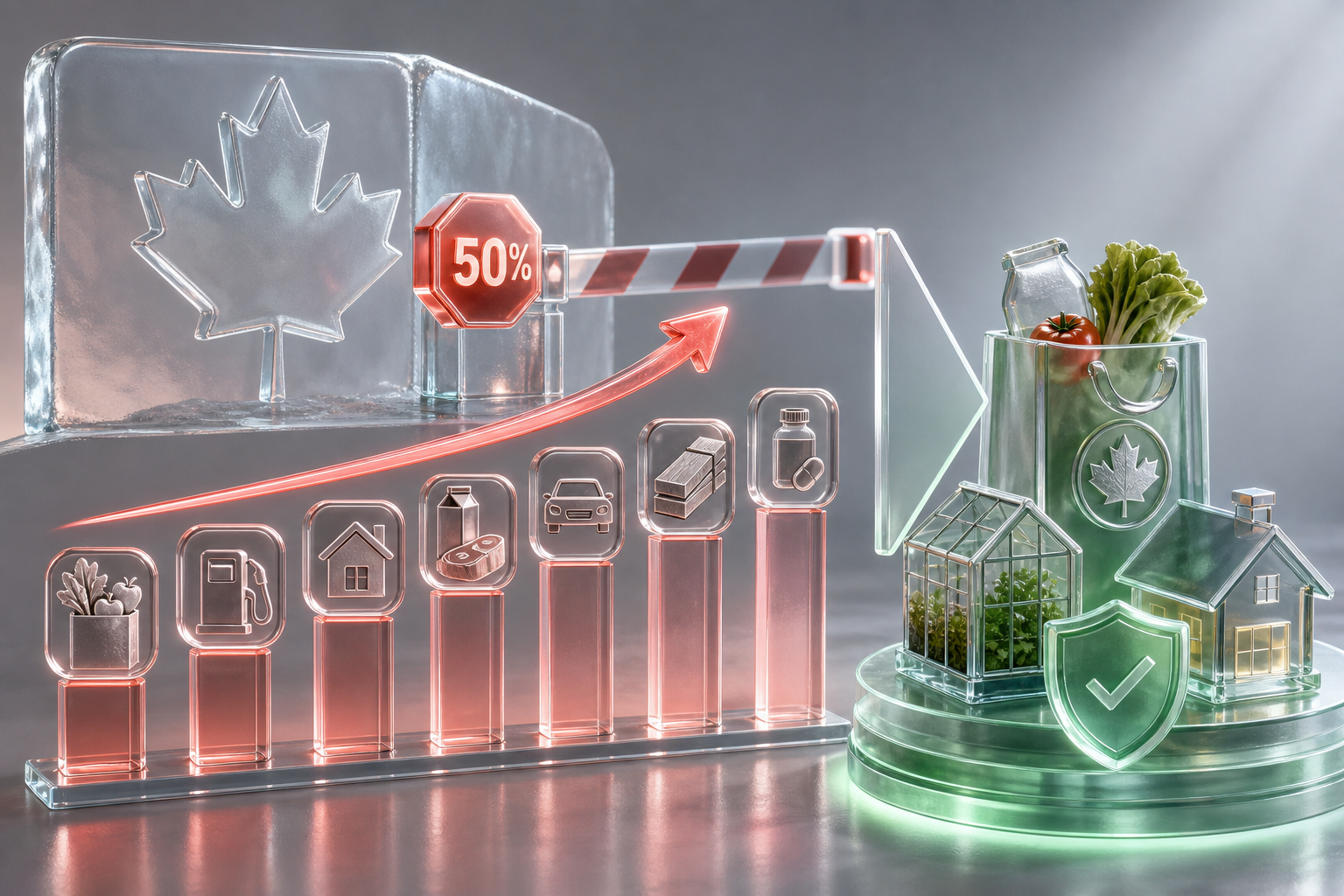

You have three weeks. August 19 marks the day 50% tariffs hit Canadian goods crossing south, and your grocery bill, mortgage rate, and gas tank are already on the list. Here's what actually costs more and what you can do before the clock runs out.
1. Groceries, especially produce, dairy, and meat
Buy Canadian now, then keep doing it. The US sources roughly 60% of Canada's fresh produce imports during winter months. When retaliatory tariffs land on American apples, lettuce, and berries, the price premium on imports becomes prohibitive. Switch to domestic brands before August 19. Lactantia, Gay Lea, and Maple Leaf are all Canadian-owned. For produce, look for country-of-origin labels, Ontario greenhouse tomatoes and BC blueberries cost the same or less year-round once the tariff kicks in.
2. Gas and heating oil
Fill your tank on August 18. Then ride it out. Canada exports oil to the US, but refined gasoline flows both ways. Tariffs disrupt cross-border refinery logistics, which historically spikes prices at the pump by 8-12 cents per litre within 60 days. A single pre-tariff fill saves you $6-9 on a 60-litre tank. For home heating oil, if you have the storage and use oil heat, top up your tank in early August. Prices lag the tariff date by two to three weeks, but once they move, they stay elevated.
3. Cars and auto parts
If you're buying, close before August 19. If you're not, skip the dealer for a year. Automotive supply chains cross the border five or six times during assembly. A 50% tariff compounds. The average new vehicle sold in Canada contains $8,000-12,000 in US-sourced components. Dealers will pass that through as a price hike or a "market adjustment fee" starting in September. Used cars spike next because new inventory dries up. If you're midway through negotiations, speed it up. If you're not actively shopping, your 2019 Civic just became worth more. Keep it.
4. Electronics and appliances
Order anything big by August 10. Laptops, TVs, fridges, and washing machines are overwhelmingly US-assembled or US-imported. A $1,200 laptop becomes $1,400-1,500 once retailers restock post-tariff. Best Buy, Costco, and Amazon.ca all restock on 30-45 day cycles. Anything you order now arrives pre-tariff. Anything you order in September does not. If your fridge or stove is marginal, replace it in the next two weeks. Waiting until October costs you $300-600.
5. Your mortgage rate (indirectly)
Lock in a rate hold if you're renewing in the next six months. Tariffs are inflationary. The Bank of Canada has already flagged them as an "upside risk" to the 2.5% inflation target. If inflation stays elevated, the overnight rate stays at 4.25% or climbs instead of dropping to 3.75% by year-end as markets priced in June. For a $400,000 mortgage renewing from 2.8% to 4.5%, that's an extra $520/month. Most lenders let you lock a rate 120 days out. If your renewal falls between now and February 2027, lock it this week. Rates only move one direction if this tariff holds.
6. Clothing and footwear
Stock up on basics. Skip luxury. US-made jeans, sneakers, and outerwear get hit immediately. Levi's, Nike, and Patagonia all manufacture south of the border. A $90 pair of Nikes becomes $115-120 by fall. Canadian Tire, Marks, and Costco source more from Asia and dodge the worst, but even their prices climb as competitors raise floors. Buy your kids' back-to-school wardrobe now. Adults: two pairs of winter boots, a good coat, four pairs of jeans. You'll wear them anyway.
7. Alcohol, especially bourbon, wine, and craft beer
Buy American bottles this month. After August, drink Canadian. Bourbon, California wine, and US craft beer are political retaliation targets every single time. Canada's 2018 response included 10% tariffs on Kentucky bourbon. Expect the same or worse. A $50 bottle of Blanton's becomes $60-65 once Ottawa's counter-tariffs post. Stock your bar now if you care. After that, Quebec wine, BC spirits, and Ontario craft beer all gain share because the import premium becomes unworkable.
The pattern is consistent: anything crossing the border more than once in production gets hit hardest. Anything with a US-only supply chain becomes unaffordable. Your move is simple. Buy now if you need it in the next year. Switch to domestic alternatives when you restock.
Read Next
Canada's Big Six banks hit $37.5 billion in impaired loans, triple pre-pandemic levels
Your 2.5% Mortgage Rate and Ontario Divorce: 7 Ways to Keep or Share It
Fixed Mortgage Rates Climb as Bond Yields Erase Discount Room
Manulife One at 4.95% vs. Five-Year Fixed at 3.94%: The Shrinking Cash Flow Advantage