Advanced mortgage strategies from a twenty-year strategist. Written to help you pay off sooner, save more, and retire three to four times wealthier — without paying more each month.
Canada's 50% Counter-Tariffs Will Hurt Canadian Consumers More Than Trump
The checkout scanner at a Metro in Etobicoke tells you something a Cabinet statement cannot: what tariffs cost at the register. A four-litre jug of milk rose after Ottawa imposed a 50% tariff on U.S. dairy in August 2026. The American imports that tariff hits represent maybe 8% of the fluid milk on Canadian shelves. The price went up on all of it.
That's the arithmetic nobody wants to talk about when tariff announcements get made. Prime Minister Mark Carney matched Trump's 50% levy with counter-tariffs on U.S. dairy and steel in August 2026, and rolled out emergency business supports at the same time. The framing was defensive: protect supply management, defend the steel sector, stand firm. The economic reality is simpler. Tariffs are a consumption tax. They get paid at the border and passed through at the register. Canadians buying groceries and building houses pay them, not policymakers in Washington.
The tariff cost flows straight through to the customer
Dairy is managed supply in Canada. That system was designed to stabilize prices by restricting entry and matching production to domestic demand. It works when the border is functionally closed. The 50% tariff on U.S. imports doesn't close the border; it raises the floor. A dairy processor in Ontario purchasing milk from U.S. suppliers faces higher input costs after the tariff. Their costs went up 50%. Supply management means they can't expand domestic production overnight to replace that volume. The price adjusts to the new cost base. The tariff shows up in the retail price within two billing cycles. There is no other path.
Steel works the same way but hits more sectors. The Canadian construction and automotive industries run on integrated North American supply chains. Manufacturers sourcing structural steel from the U.S. face higher input costs after the tariff. That shows up in the bid for the condo tower going up in Liberty Village. It shows up in the cost of the F-150 rolling off the line in Oakville. The 50% tariff doesn't make the Indiana mill less competitive. It makes everything built with that steel more expensive for the end buyer, who is Canadian.
The Trump administration's tariffs hurt the U.S. economy. They raise costs for American businesses buying Canadian aluminum and softwood lumber. That's real. But Trump's tariffs fall on industries where the U.S. has alternatives, other suppliers, stockpiles, the ability to wait it out. Canada's counter-tariffs fall on dairy and steel, two inputs where Canada has limited short-term substitutes and where the cost gets passed directly to the domestic consumer base. A tariff on Vermont cheddar makes cheddar more expensive in Canada. It doesn't make cheddar cheaper anywhere.
The support programs won't reach most of the pain
The federal government announced business support tied to the tariff package. That's fine for Saputo or Stelco, large players with enough staff and lawyers to navigate the application forms and compliance requirements. A small contractor in Barrie who just saw their steel quote go up 50% doesn't have those people on staff. The pain hits in days. The support arrives in months, if at all, and only after filing applications through Innovation, Science and Economic Development Canada.
Trump can afford to let this run. His base isn't buying Canadian dairy. Carney is governing a country where roughly 72% of exports go south and where the CPI for food and housing materials is about to move against him in a way that shows up in every household budget by Christmas. Retaliation signals resolve. It doesn't change who pays the bill.
Sources
Prime Minister of Canada - Official Prime Minister Homepage - 2026-08-27. https://www.pm.gc.ca/en


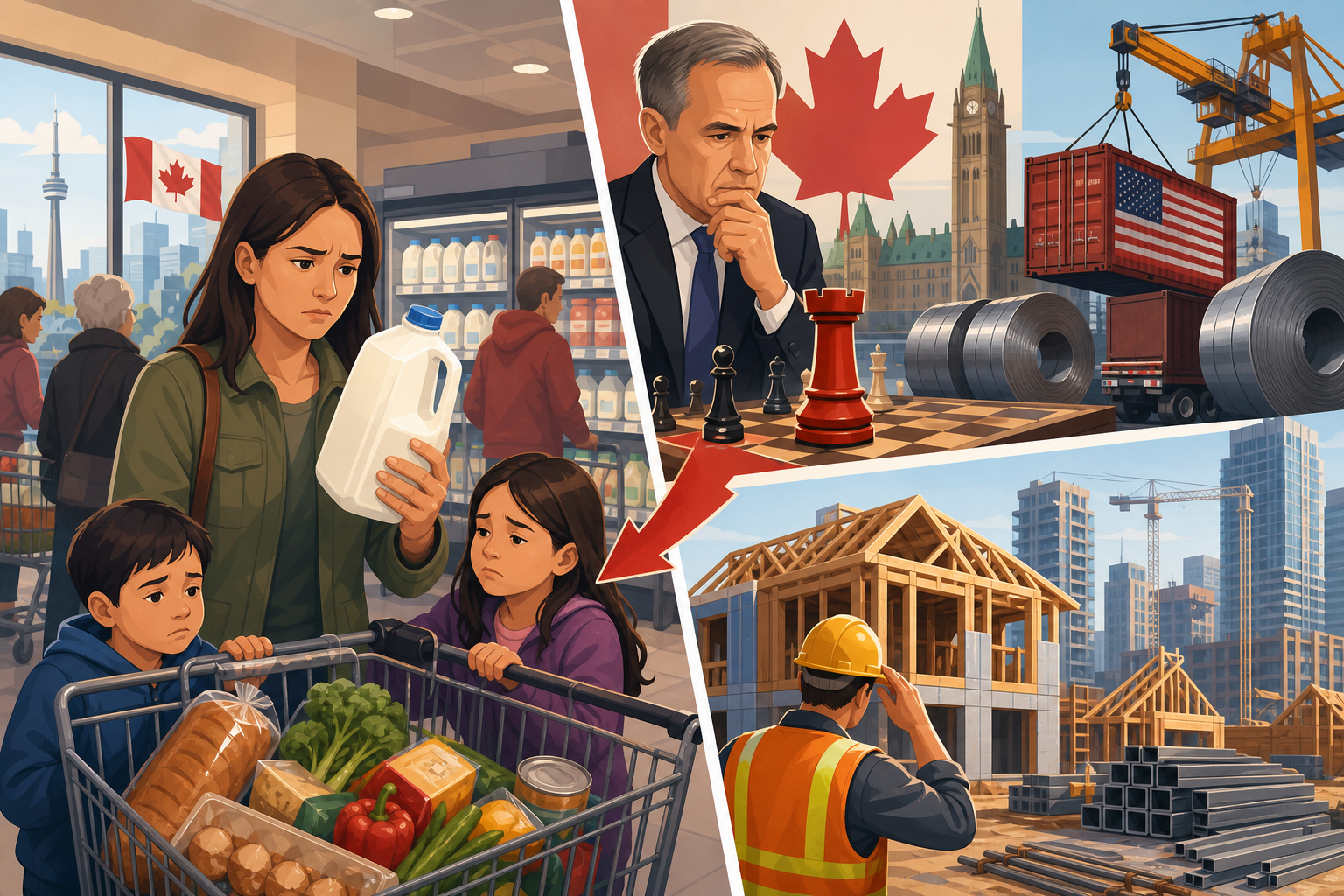

The checkout scanner at a Metro in Etobicoke tells you something a Cabinet statement cannot: what tariffs cost at the register. A four-litre jug of milk rose after Ottawa imposed a 50% tariff on U.S. dairy in August 2026. The American imports that tariff hits represent maybe 8% of the fluid milk on Canadian shelves. The price went up on all of it.
That's the arithmetic nobody wants to talk about when tariff announcements get made. Prime Minister Mark Carney matched Trump's 50% levy with counter-tariffs on U.S. dairy and steel in August 2026, and rolled out emergency business supports at the same time. The framing was defensive: protect supply management, defend the steel sector, stand firm. The economic reality is simpler. Tariffs are a consumption tax. They get paid at the border and passed through at the register. Canadians buying groceries and building houses pay them, not policymakers in Washington.
The tariff cost flows straight through to the customer
Dairy is managed supply in Canada. That system was designed to stabilize prices by restricting entry and matching production to domestic demand. It works when the border is functionally closed. The 50% tariff on U.S. imports doesn't close the border; it raises the floor. A dairy processor in Ontario purchasing milk from U.S. suppliers faces higher input costs after the tariff. Their costs went up 50%. Supply management means they can't expand domestic production overnight to replace that volume. The price adjusts to the new cost base. The tariff shows up in the retail price within two billing cycles. There is no other path.
Steel works the same way but hits more sectors. The Canadian construction and automotive industries run on integrated North American supply chains. Manufacturers sourcing structural steel from the U.S. face higher input costs after the tariff. That shows up in the bid for the condo tower going up in Liberty Village. It shows up in the cost of the F-150 rolling off the line in Oakville. The 50% tariff doesn't make the Indiana mill less competitive. It makes everything built with that steel more expensive for the end buyer, who is Canadian.
The Trump administration's tariffs hurt the U.S. economy. They raise costs for American businesses buying Canadian aluminum and softwood lumber. That's real. But Trump's tariffs fall on industries where the U.S. has alternatives, other suppliers, stockpiles, the ability to wait it out. Canada's counter-tariffs fall on dairy and steel, two inputs where Canada has limited short-term substitutes and where the cost gets passed directly to the domestic consumer base. A tariff on Vermont cheddar makes cheddar more expensive in Canada. It doesn't make cheddar cheaper anywhere.
The support programs won't reach most of the pain
The federal government announced business support tied to the tariff package. That's fine for Saputo or Stelco, large players with enough staff and lawyers to navigate the application forms and compliance requirements. A small contractor in Barrie who just saw their steel quote go up 50% doesn't have those people on staff. The pain hits in days. The support arrives in months, if at all, and only after filing applications through Innovation, Science and Economic Development Canada.
Trump can afford to let this run. His base isn't buying Canadian dairy. Carney is governing a country where roughly 72% of exports go south and where the CPI for food and housing materials is about to move against him in a way that shows up in every household budget by Christmas. Retaliation signals resolve. It doesn't change who pays the bill.
Sources
Read Next
Canada's Big Six banks hit $37.5 billion in impaired loans, triple pre-pandemic levels
Your 2.5% Mortgage Rate and Ontario Divorce: 7 Ways to Keep or Share It
Fixed Mortgage Rates Climb as Bond Yields Erase Discount Room
Manulife One at 4.95% vs. Five-Year Fixed at 3.94%: The Shrinking Cash Flow Advantage