Advanced mortgage strategies from a twenty-year strategist. Written to help you pay off sooner, save more, and retire three to four times wealthier — without paying more each month.
Canada's insolvency surge isn't about job losses, it's about the gap between what households owe and what they can service
Canada's insolvency surge isn't about job losses, it's about the gap between what households owe and what they can service
Roughly 410 Canadians filed for insolvency every day in the second quarter of 2026. Not because they lost their jobs. Because the mortgage renewal arrived.
The Office of the Superintendent of Bankruptcy logged 37,238 consumer filings in Q2 2026, up 6.9 per cent year-over-year. On a seasonally adjusted basis, filings climbed 3.5 per cent over the previous quarter. The trajectory puts Canada within reach of surpassing the 2009 peak, the worst insolvency year on record, sometime in the next twelve months. But the underlying dynamic looks nothing like 2009. Back then, unemployment spiked to 8.7 per cent and people filed because they couldn't find work. Today, the labor market is holding. The unemployment rate sits in the mid-six-percent range. Most of the households walking into insolvency trustees' offices have jobs. They just can't cover the payments anymore.
The arithmetic changed faster than incomes could adjust
Consider a homeowner who locked in a five-year fixed mortgage at 1.79 per cent in 2021. Monthly payment on a $500,000 balance: roughly $2,100. That same household renewing in 2025 or 2026 at 4.8 per cent faces a payment north of $2,900. The income didn't move. The house is still worth roughly what it was. But $800 a month vanished from the discretionary column, and for a household already running tight margins on daycare, car payments, and groceries that have climbed 20 per cent since 2021, the wedge is fatal.
The filings reflect that wedge. Consumer proposals, formal agreements to repay a fraction of total debt in exchange for creditor forbearance, now represent roughly 75 to 80 per cent of total insolvencies, up from historical norms closer to 60 per cent. Proposals are the tool people use when they want to keep the house, keep the car, and restructure everything else. Bankruptcies, by contrast, remain flat or have declined slightly. That distribution tells you this isn't a collapse in earning capacity. It's a cash-flow problem dressed up as solvency.
The provinces where housing debt concentrated are leading the count
British Columbia and Ontario are driving the national increase, which tracks perfectly with where mortgage balances ran highest relative to income. A household in Metro Vancouver or the Greater Toronto Area carrying a $700,000 mortgage and a $40,000 HELOC used to fund kitchen renovations in 2022 is now servicing both at rates three times what they were paying four years ago. The income side hasn't tripled. Inflation cooled, but prices didn't roll back. The gap widened until the household ran out of room.
Business filings tell a similar story. The twelve months ending June 2026 saw a 41.4 per cent increase in business insolvencies compared to the prior year, with Q2 alone logging 1,541 filings, up 15 per cent quarter-over-quarter. Those aren't wholesale failures of demand. They're cash-flow deaths by a thousand cuts: higher rent, higher payroll to match inflation, higher interest on operating lines that were cheap three years ago.
We are witnessing the lag, not the impact
Insolvencies typically peak twelve to eighteen months after interest rates hit their ceiling, because it takes that long for households to burn through savings, max the credit cards, defer the property tax installment, and realize the math doesn't close. The Bank of Canada's rate-cutting cycle, which began mid-2025, hasn't filtered through to most renewal cohorts yet. The households filing now locked in their pain in 2024 and early 2025. The ones renewing in late 2026 and 2027 will benefit from modestly lower rates, but only modestly. A drop from 4.8 per cent to 4.2 per cent helps. It doesn't restore the $800.
Canada's household debt-to-income ratio remains among the highest in the G7. That ratio was manageable when the cost of servicing it was trivial. Strip away the subsidy of near-zero rates, and the structure reveals itself: a system built for cheap money that has no cushion when money stops being cheap. The insolvency count is just the lagging indicator of that mismatch finally showing up in the data.


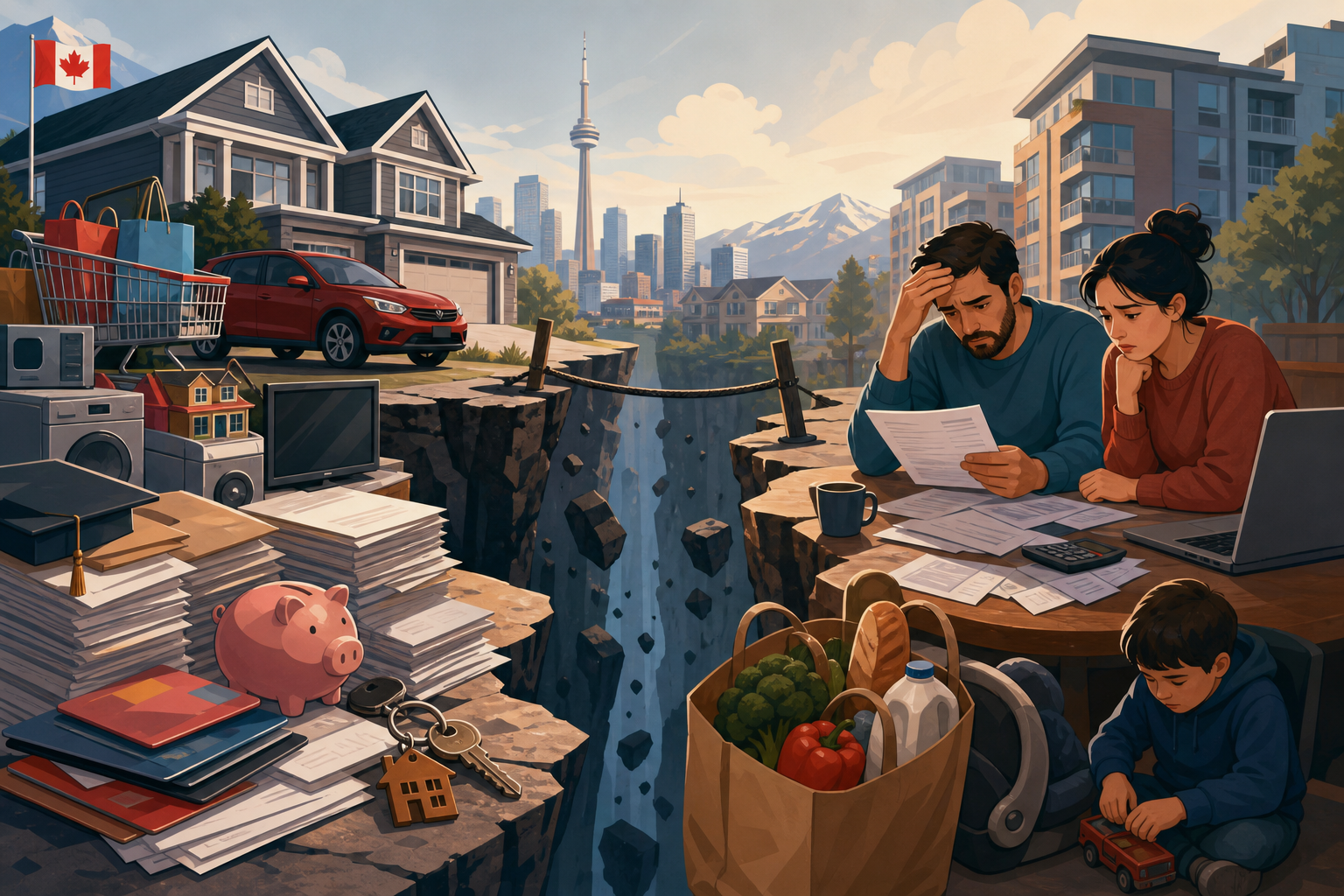

Canada's insolvency surge isn't about job losses, it's about the gap between what households owe and what they can service
Roughly 410 Canadians filed for insolvency every day in the second quarter of 2026. Not because they lost their jobs. Because the mortgage renewal arrived.
The Office of the Superintendent of Bankruptcy logged 37,238 consumer filings in Q2 2026, up 6.9 per cent year-over-year. On a seasonally adjusted basis, filings climbed 3.5 per cent over the previous quarter. The trajectory puts Canada within reach of surpassing the 2009 peak, the worst insolvency year on record, sometime in the next twelve months. But the underlying dynamic looks nothing like 2009. Back then, unemployment spiked to 8.7 per cent and people filed because they couldn't find work. Today, the labor market is holding. The unemployment rate sits in the mid-six-percent range. Most of the households walking into insolvency trustees' offices have jobs. They just can't cover the payments anymore.
The arithmetic changed faster than incomes could adjust
Consider a homeowner who locked in a five-year fixed mortgage at 1.79 per cent in 2021. Monthly payment on a $500,000 balance: roughly $2,100. That same household renewing in 2025 or 2026 at 4.8 per cent faces a payment north of $2,900. The income didn't move. The house is still worth roughly what it was. But $800 a month vanished from the discretionary column, and for a household already running tight margins on daycare, car payments, and groceries that have climbed 20 per cent since 2021, the wedge is fatal.
The filings reflect that wedge. Consumer proposals, formal agreements to repay a fraction of total debt in exchange for creditor forbearance, now represent roughly 75 to 80 per cent of total insolvencies, up from historical norms closer to 60 per cent. Proposals are the tool people use when they want to keep the house, keep the car, and restructure everything else. Bankruptcies, by contrast, remain flat or have declined slightly. That distribution tells you this isn't a collapse in earning capacity. It's a cash-flow problem dressed up as solvency.
The provinces where housing debt concentrated are leading the count
British Columbia and Ontario are driving the national increase, which tracks perfectly with where mortgage balances ran highest relative to income. A household in Metro Vancouver or the Greater Toronto Area carrying a $700,000 mortgage and a $40,000 HELOC used to fund kitchen renovations in 2022 is now servicing both at rates three times what they were paying four years ago. The income side hasn't tripled. Inflation cooled, but prices didn't roll back. The gap widened until the household ran out of room.
Business filings tell a similar story. The twelve months ending June 2026 saw a 41.4 per cent increase in business insolvencies compared to the prior year, with Q2 alone logging 1,541 filings, up 15 per cent quarter-over-quarter. Those aren't wholesale failures of demand. They're cash-flow deaths by a thousand cuts: higher rent, higher payroll to match inflation, higher interest on operating lines that were cheap three years ago.
We are witnessing the lag, not the impact
Insolvencies typically peak twelve to eighteen months after interest rates hit their ceiling, because it takes that long for households to burn through savings, max the credit cards, defer the property tax installment, and realize the math doesn't close. The Bank of Canada's rate-cutting cycle, which began mid-2025, hasn't filtered through to most renewal cohorts yet. The households filing now locked in their pain in 2024 and early 2025. The ones renewing in late 2026 and 2027 will benefit from modestly lower rates, but only modestly. A drop from 4.8 per cent to 4.2 per cent helps. It doesn't restore the $800.
Canada's household debt-to-income ratio remains among the highest in the G7. That ratio was manageable when the cost of servicing it was trivial. Strip away the subsidy of near-zero rates, and the structure reveals itself: a system built for cheap money that has no cushion when money stops being cheap. The insolvency count is just the lagging indicator of that mismatch finally showing up in the data.
Read Next
Canada's Big Six banks hit $37.5 billion in impaired loans, triple pre-pandemic levels
Your 2.5% Mortgage Rate and Ontario Divorce: 7 Ways to Keep or Share It
Fixed Mortgage Rates Climb as Bond Yields Erase Discount Room
Manulife One at 4.95% vs. Five-Year Fixed at 3.94%: The Shrinking Cash Flow Advantage