Advanced mortgage strategies from a twenty-year strategist. Written to help you pay off sooner, save more, and retire three to four times wealthier — without paying more each month.
Canada's Rental Boom Is Solving the Wrong Housing Crisis
A 35-year-old couple in Etobicoke earning a combined $140,000 per year has, over the last five years, been saving toward a down payment on a two-bedroom condo. They now have roughly $75,000 set aside. The problem is that the two-bedroom condos they've been tracking, units that sold for $550,000 in 2021, are no longer being built. The towers going up in their neighborhood are purpose-built rentals, some with studio and one-bedroom layouts optimized for professional management, none for sale at any price.
That scenario is playing out across Toronto, Vancouver, and a dozen other urban centers where developers have executed a near-total pivot from ownership condos to rental apartments. Roughly 130,000 purpose-built rental units were under construction across Canada as of early 2024, a multi-decade high. Federal GST exemptions and CMHC's MLI Select financing have turned rental projects into the only game in town for developers navigating high borrowing costs and a collapsed investor base. The construction sector has not stopped building. It has stopped building anything you can buy.
The Ownership Ladder Just Lost Its Bottom Rung
For the past decade, the entry point into Canadian homeownership was a small condo. Not a house. Not a townhome. A 600-square-foot box in a tower, usually purchased with help from family, usually cash-flow negative if you rented it out, but an asset that let you start building equity while the market moved. That channel is now effectively closed. Condo starts have fallen sharply, mom-and-pop investors who sustained pre-construction sales can no longer make the math work at current interest rates, and developers have shifted capital into rental projects where institutional buyers and government-backed insurance eliminate demand risk.
The couple in Etobicoke isn't worse off because rentals are being built. They're worse off because the thing they were working toward, a modestly-priced ownership unit within commuting distance of their jobs, has been structurally removed from the supply pipeline. The First Home Savings Account lets them shelter $8,000 a year. That's helpful. It does not solve the problem that the homes they could afford to buy in 2021 are no longer being delivered to market in 2026.
Rentals Serve a Different Population
The rental boom is real and necessary. The units going up now will provide housing for tens of thousands of people who need it. But the tenant base for purpose-built rentals skews heavily toward smaller households, singles, couples without children, and recent immigrants in the early stages of settlement. A family with two kids in elementary school does not typically choose a professionally managed one-bedroom rental as a long-term solution. They need space, stability, and the option to modify their living environment in ways that landlords do not permit.
The mismatch is structural. The pipeline delivering new rental supply is not the same pipeline that delivers ownership stock for households trying to graduate out of renting. Desjardins warns that the current development model creates an "ownership gap" precisely where first-time buyers have historically entered the market. When condo starts resume, and they will, eventually, the lag is measured in years. Projects that don't break ground in 2026 won't deliver units until 2029 or later. The family saving for a down payment is left with a choice: wait indefinitely, or abandon the ownership track altogether and resign themselves to decades of rent increases governed by whatever political constraints happen to be in place at the time.
What Gets Incentivized Gets Built
Government policy has spoken clearly. Rental construction gets GST relief, favorable CMHC financing, and municipal zoning that protects rental-only designations from conversion. Ownership construction gets none of that. The result is not balanced supply. It's a boom in one segment and a drought in the other. That might make sense if the demand side were equally lopsided. It isn't. Household formation, immigration targets, and long-term demographic trends all point to growing demand for family-sized ownership housing. But the buildings going up now are not family-sized and are not for sale.
The couple in Etobicoke will keep renting. Their $75,000 will sit in a savings account, earning modest returns while the gap between what they have and what they need widens. The rental boom is solving a real problem. Just not theirs.


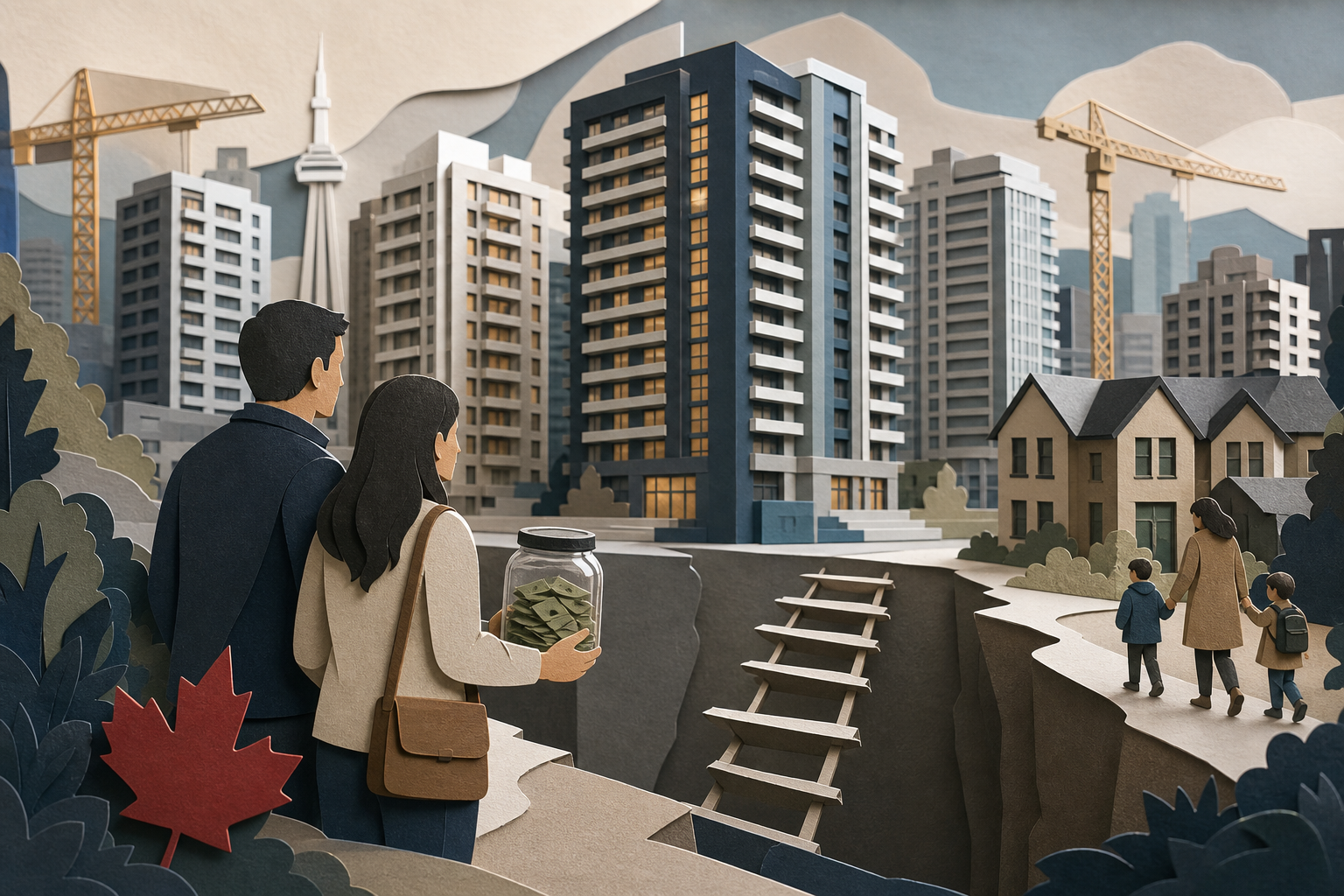

A 35-year-old couple in Etobicoke earning a combined $140,000 per year has, over the last five years, been saving toward a down payment on a two-bedroom condo. They now have roughly $75,000 set aside. The problem is that the two-bedroom condos they've been tracking, units that sold for $550,000 in 2021, are no longer being built. The towers going up in their neighborhood are purpose-built rentals, some with studio and one-bedroom layouts optimized for professional management, none for sale at any price.
That scenario is playing out across Toronto, Vancouver, and a dozen other urban centers where developers have executed a near-total pivot from ownership condos to rental apartments. Roughly 130,000 purpose-built rental units were under construction across Canada as of early 2024, a multi-decade high. Federal GST exemptions and CMHC's MLI Select financing have turned rental projects into the only game in town for developers navigating high borrowing costs and a collapsed investor base. The construction sector has not stopped building. It has stopped building anything you can buy.
The Ownership Ladder Just Lost Its Bottom Rung
For the past decade, the entry point into Canadian homeownership was a small condo. Not a house. Not a townhome. A 600-square-foot box in a tower, usually purchased with help from family, usually cash-flow negative if you rented it out, but an asset that let you start building equity while the market moved. That channel is now effectively closed. Condo starts have fallen sharply, mom-and-pop investors who sustained pre-construction sales can no longer make the math work at current interest rates, and developers have shifted capital into rental projects where institutional buyers and government-backed insurance eliminate demand risk.
The couple in Etobicoke isn't worse off because rentals are being built. They're worse off because the thing they were working toward, a modestly-priced ownership unit within commuting distance of their jobs, has been structurally removed from the supply pipeline. The First Home Savings Account lets them shelter $8,000 a year. That's helpful. It does not solve the problem that the homes they could afford to buy in 2021 are no longer being delivered to market in 2026.
Rentals Serve a Different Population
The rental boom is real and necessary. The units going up now will provide housing for tens of thousands of people who need it. But the tenant base for purpose-built rentals skews heavily toward smaller households, singles, couples without children, and recent immigrants in the early stages of settlement. A family with two kids in elementary school does not typically choose a professionally managed one-bedroom rental as a long-term solution. They need space, stability, and the option to modify their living environment in ways that landlords do not permit.
The mismatch is structural. The pipeline delivering new rental supply is not the same pipeline that delivers ownership stock for households trying to graduate out of renting. Desjardins warns that the current development model creates an "ownership gap" precisely where first-time buyers have historically entered the market. When condo starts resume, and they will, eventually, the lag is measured in years. Projects that don't break ground in 2026 won't deliver units until 2029 or later. The family saving for a down payment is left with a choice: wait indefinitely, or abandon the ownership track altogether and resign themselves to decades of rent increases governed by whatever political constraints happen to be in place at the time.
What Gets Incentivized Gets Built
Government policy has spoken clearly. Rental construction gets GST relief, favorable CMHC financing, and municipal zoning that protects rental-only designations from conversion. Ownership construction gets none of that. The result is not balanced supply. It's a boom in one segment and a drought in the other. That might make sense if the demand side were equally lopsided. It isn't. Household formation, immigration targets, and long-term demographic trends all point to growing demand for family-sized ownership housing. But the buildings going up now are not family-sized and are not for sale.
The couple in Etobicoke will keep renting. Their $75,000 will sit in a savings account, earning modest returns while the gap between what they have and what they need widens. The rental boom is solving a real problem. Just not theirs.
Read Next
Canada's Big Six banks hit $37.5 billion in impaired loans, triple pre-pandemic levels
Your 2.5% Mortgage Rate and Ontario Divorce: 7 Ways to Keep or Share It
Fixed Mortgage Rates Climb as Bond Yields Erase Discount Room
Manulife One at 4.95% vs. Five-Year Fixed at 3.94%: The Shrinking Cash Flow Advantage