Advanced mortgage strategies from a twenty-year strategist. Written to help you pay off sooner, save more, and retire three to four times wealthier — without paying more each month.
Kelowna Now Ranks First in Canada for Wildfire Risk, What That Means for Condo Buyers
Natural Resources Canada's 2026 forecasting model now scores Kelowna in the 90th percentile for wildfire risk among Canadian municipalities. The shift from regional threat to national leader happened in the span of three years, largely driven by the 2023 McDougall Creek fire, which forced 10,000 evacuations and burned within blocks of multi-family developments overlooking the lake.
For condo buyers, this ranking is more than an academic concern. It determines whether the building you're considering can actually hold insurance.
Why the ranking affects strata insurance directly
Insurers use national risk scores to set premiums and determine coverage eligibility. In the Okanagan, some strata corporations have seen wildfire and earthquake deductibles climb into six figures since 2025. A few have been dropped entirely, forcing them into the high-risk insurer pool where premiums can double.
A buyer might secure a mortgage, but if the strata's master insurance policy becomes unaffordable or unavailable, the individual unit's value can collapse. The Insurance Bureau of Canada has flagged this as a growing exposure in BC's interior, buildings that are structurally sound but financially uninsurable.
Strata councils are responding by pursuing FireSmart Canada certification, the provincial standard for property mitigation. Many insurers now require it to maintain coverage. That typically means clearing vegetation within 10 meters of the building, replacing combustible landscaping (ornamental cedars, junipers), and upgrading exterior cladding where possible. The work isn't optional. It's becoming a condition of renewal.
What newer buildings are doing differently
Developments built after 2021 are designing for the ranked risk from the start. Non-combustible cladding, fiber cement, metal panels, is now standard in high-exposure zones. HVAC systems are specified with MERV 13 or higher filtration to manage fine particulate matter during smoke season, when Kelowna's Air Quality Health Index can stay at "10+" for days.
These aren't luxury features. They're survival infrastructure. Kelowna has shifted to year-round smoke management, not just fire season preparation. A building that lacks proper air handling becomes unlivable in July and August, when wildfire smoke from surrounding areas settles into the valley.
Concrete-and-steel high-rises downtown have significantly lower structural fire risk than older wood-frame low-rises in the hillside zones. The construction method matters as much as the location. A three-story wood-frame walkup built in 2015 carries different exposure than a 12-story concrete tower built in 2024, even if they sit on adjacent blocks.
The landscape liability most buyers miss
Look at the courtyard. If it's full of ornamental cedars, Douglas firs, or dense shrubs pressed against the building envelope, you're looking at a future special assessment. FireSmart guidelines require defensible space, and retrofitting an established landscape runs $15,000 to $40,000 per building depending on scope.
The City of Kelowna's 2040 Official Community Plan shifts responsibility for wildfire protection from the fire department to private property design. Buildings that don't comply face escalating insurance costs and, in some cases, denial of occupancy permits for new units during redevelopment.
Buyers should request three documents before making an offer: the strata's current insurance policy (including wildfire deductible), the most recent FireSmart assessment if one exists, and any depreciation report notes related to exterior cladding or landscaping. If the strata hasn't addressed these, the cost will eventually land on unit owners through special levies.
The ranking isn't going to improve. BC Wildfire Service has moved to a year-round management model with a budget exceeding $200 million for 2025/2026. The province is planning for higher frequency, not lower. Buildings that adapt now will hold value. The ones that defer mitigation will price it in later, through insurance premiums, special assessments, or resale discounts that reflect unmanaged risk.


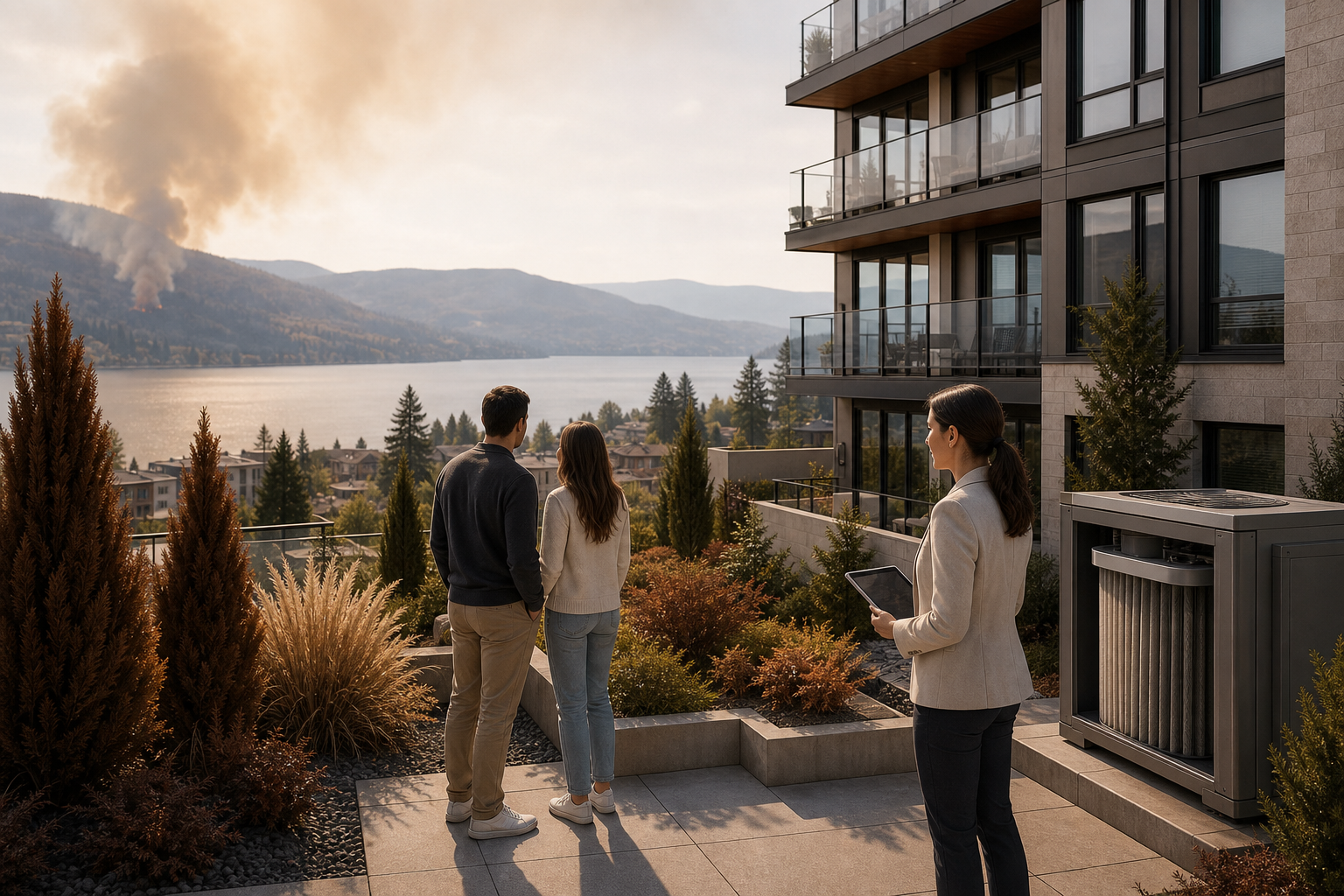

Natural Resources Canada's 2026 forecasting model now scores Kelowna in the 90th percentile for wildfire risk among Canadian municipalities. The shift from regional threat to national leader happened in the span of three years, largely driven by the 2023 McDougall Creek fire, which forced 10,000 evacuations and burned within blocks of multi-family developments overlooking the lake.
For condo buyers, this ranking is more than an academic concern. It determines whether the building you're considering can actually hold insurance.
Why the ranking affects strata insurance directly
Insurers use national risk scores to set premiums and determine coverage eligibility. In the Okanagan, some strata corporations have seen wildfire and earthquake deductibles climb into six figures since 2025. A few have been dropped entirely, forcing them into the high-risk insurer pool where premiums can double.
A buyer might secure a mortgage, but if the strata's master insurance policy becomes unaffordable or unavailable, the individual unit's value can collapse. The Insurance Bureau of Canada has flagged this as a growing exposure in BC's interior, buildings that are structurally sound but financially uninsurable.
Strata councils are responding by pursuing FireSmart Canada certification, the provincial standard for property mitigation. Many insurers now require it to maintain coverage. That typically means clearing vegetation within 10 meters of the building, replacing combustible landscaping (ornamental cedars, junipers), and upgrading exterior cladding where possible. The work isn't optional. It's becoming a condition of renewal.
What newer buildings are doing differently
Developments built after 2021 are designing for the ranked risk from the start. Non-combustible cladding, fiber cement, metal panels, is now standard in high-exposure zones. HVAC systems are specified with MERV 13 or higher filtration to manage fine particulate matter during smoke season, when Kelowna's Air Quality Health Index can stay at "10+" for days.
These aren't luxury features. They're survival infrastructure. Kelowna has shifted to year-round smoke management, not just fire season preparation. A building that lacks proper air handling becomes unlivable in July and August, when wildfire smoke from surrounding areas settles into the valley.
Concrete-and-steel high-rises downtown have significantly lower structural fire risk than older wood-frame low-rises in the hillside zones. The construction method matters as much as the location. A three-story wood-frame walkup built in 2015 carries different exposure than a 12-story concrete tower built in 2024, even if they sit on adjacent blocks.
The landscape liability most buyers miss
Look at the courtyard. If it's full of ornamental cedars, Douglas firs, or dense shrubs pressed against the building envelope, you're looking at a future special assessment. FireSmart guidelines require defensible space, and retrofitting an established landscape runs $15,000 to $40,000 per building depending on scope.
The City of Kelowna's 2040 Official Community Plan shifts responsibility for wildfire protection from the fire department to private property design. Buildings that don't comply face escalating insurance costs and, in some cases, denial of occupancy permits for new units during redevelopment.
Buyers should request three documents before making an offer: the strata's current insurance policy (including wildfire deductible), the most recent FireSmart assessment if one exists, and any depreciation report notes related to exterior cladding or landscaping. If the strata hasn't addressed these, the cost will eventually land on unit owners through special levies.
The ranking isn't going to improve. BC Wildfire Service has moved to a year-round management model with a budget exceeding $200 million for 2025/2026. The province is planning for higher frequency, not lower. Buildings that adapt now will hold value. The ones that defer mitigation will price it in later, through insurance premiums, special assessments, or resale discounts that reflect unmanaged risk.
Read Next
Canada's Big Six banks hit $37.5 billion in impaired loans, triple pre-pandemic levels
Your 2.5% Mortgage Rate and Ontario Divorce: 7 Ways to Keep or Share It
Fixed Mortgage Rates Climb as Bond Yields Erase Discount Room
Manulife One at 4.95% vs. Five-Year Fixed at 3.94%: The Shrinking Cash Flow Advantage