Advanced mortgage strategies from a twenty-year strategist. Written to help you pay off sooner, save more, and retire three to four times wealthier — without paying more each month.
Laneway Homes in Canada: Breaking Down the $250K Build Cost vs. Rental Return
A couple in North Vancouver spent $485,000 building a 650-square-foot laneway suite in 2024. They now rent it for $2,900 per month. At that rate, they'll recover the construction cost in roughly 14 years, not counting property tax increases, maintenance, or the carrying cost of the capital they deployed. The income looks good. The math is harder.
The advertised promise of the laneway home is simple: build a detached unit in your backyard, rent it out, offset your mortgage or fund retirement. The $250,000 figure gets floated often in city planning documents and grant applications. It's real in the same way that "average Canadian salary" is real, accurate in aggregate, misleading in application. Actual builds in Vancouver, Toronto, and Calgary are running between $350,000 and $550,000 as of mid-2026, and the gap between that number and what you'll recover through rent or property value is where the decision gets interesting.
Where the $250K Estimate Breaks
The $250,000 baseline assumes a best-case scenario: a flat, accessible lot with existing service connections close to the build site, a simple rectangular footprint with standard finishes, and no utility trenching. Most lots don't meet all those conditions.
Start with services. Running water, sewer, and electrical from the street or main house to a detached structure costs $20,000 to $40,000 in most markets, and that's before you dig. If the lot slopes, add grading and possibly retaining walls. If the city requires a separate meter for the laneway unit, add another $8,000 to $12,000. If the alley access is narrow and equipment can't stage easily, labor hours inflate. These aren't edge cases, they're normal site conditions that don't appear in the planning-stage estimate.
Permit and design fees run $15,000 to $25,000, depending on the municipality. Toronto waives development charges for laneway suites, but you still pay for architectural drawings, structural engineering, and the surveyor's report. Vancouver caps fees but doesn't eliminate them. A basic permit package in Edmonton is cheaper than Toronto, but the timeline is longer, which adds carrying cost if you're financing construction with a HELOC at 7.2%.
Then finishes. A builder will quote you "builder-grade" at one price and "comparable to your main house" at another. The difference is $40,000 to $70,000 for a 600-square-foot unit. Most people building a laneway suite in 2026 are treating it as either a long-term rental asset or future housing for aging parents. Both cases push toward higher-end finishes, and the $250,000 estimate evaporates.
Rental Income: The High-End Scenario
Assume a two-bedroom, 600-square-foot laneway home in a high-demand urban market. In Vancouver, you can rent that for $2,800 to $3,500 per month as of mid-2026. In Toronto, $2,400 to $3,000. In Calgary, $1,800 to $2,200. Those numbers are gross, before vacancy, tenant turnover, property management if you're outsourcing it, and the incremental property tax hit from the reassessment.
Take the Toronto case. Build cost: $425,000 (realistic for a turnkey unit with mid-range finishes and typical trenching). Monthly rent: $2,600. Vacancy rate: assume 5%, or one month every 20 months. Net annual rent: $29,640. Property tax increase: roughly $1,800 per year. Maintenance reserve: $1,200 per year (this is conservative; replace it with real numbers after year three). Insurance delta: $600 per year for increased liability coverage. Net annual income: $26,040.
At $26,040 per year, you recover $425,000 in 16.3 years. That's before the opportunity cost of the capital. If you pulled $425,000 from a HELOC at 7.2%, your annual interest cost is $30,600, which is more than the net rent. You're subsidizing the tenant.
If you paid cash, the opportunity cost is what that $425,000 could have earned in an index fund, which over a 15-year horizon is roughly 5% real after inflation. You're giving up $21,250 per year in expected investment returns to earn $26,040 in rent, for a net $4,790 annual advantage. Over 15 years, that's $71,850 ahead of the index fund, plus you've added a rentable asset to your property. Not transformative, but positive.
Now the Vancouver case, where rent is higher. Same $425,000 build. Monthly rent: $3,200. Net annual income after the same deductions: $36,480. You're now $15,230 per year ahead of the index fund opportunity cost. Over 15 years: $228,450. That's where the laneway home starts to look like the right move, assuming rents hold and the unit doesn't sit vacant for extended stretches.
Property Value: The Appraisal Gap Problem
Adding a laneway suite increases your property's market value, but not always by the amount you spent. The gap depends on the neighborhood, the quality of the build, and whether comparable properties nearby have laneway units. In East Vancouver, where laneway homes are common, appraisers have comps and the value lift is reliable, often 60% to 80% of construction cost. In outer suburbs or markets where laneway units are new, appraisers struggle, and you might see only 40% to 50% of the build cost reflected in the appraised value.
If you're planning to sell within five years, the appraisal gap is a real loss. If you're holding the property long-term and treating the laneway unit as an income generator, the gap matters less. The rental income compounds, the mortgage on the main house gets paid down, and the laneway suite becomes part of a larger wealth-building strategy.
The "Switch" Strategy
The highest-return scenario isn't renting out the laneway home. It's moving into it yourself and renting out the main house.
A couple in their early 60s in Toronto owns a three-bedroom home worth $1.4 million, mortgage-free. They build a 600-square-foot laneway suite for $425,000, financed via HELOC. They move into the laneway unit. They rent the main house for $4,200 per month. Net annual rental income after expenses: $47,000. That income services the HELOC and funds their property taxes, leaving them with low fixed housing costs and the option to sell the main house later without sacrificing the lifestyle flexibility of staying in the neighborhood.
This only works if you're genuinely willing to downsize to 600 square feet, but for retirees who've already downsized mentally, it's a better financial outcome than renting out the smaller unit.
When the Recommendation Flips
Build the laneway home if: rental demand in your market can support $2,800+ per month, you're planning to hold the property for at least 10 years, and you can finance construction without monthly carrying costs that exceed the rental income. Don't build if: your market rents are soft, you're planning to sell within five years, or the construction cost exceeds $500,000 without a corresponding lift in either rent or property value.
The $250,000 figure is real only in theory. Plan for $425,000 to $475,000, and make the decision on those numbers.


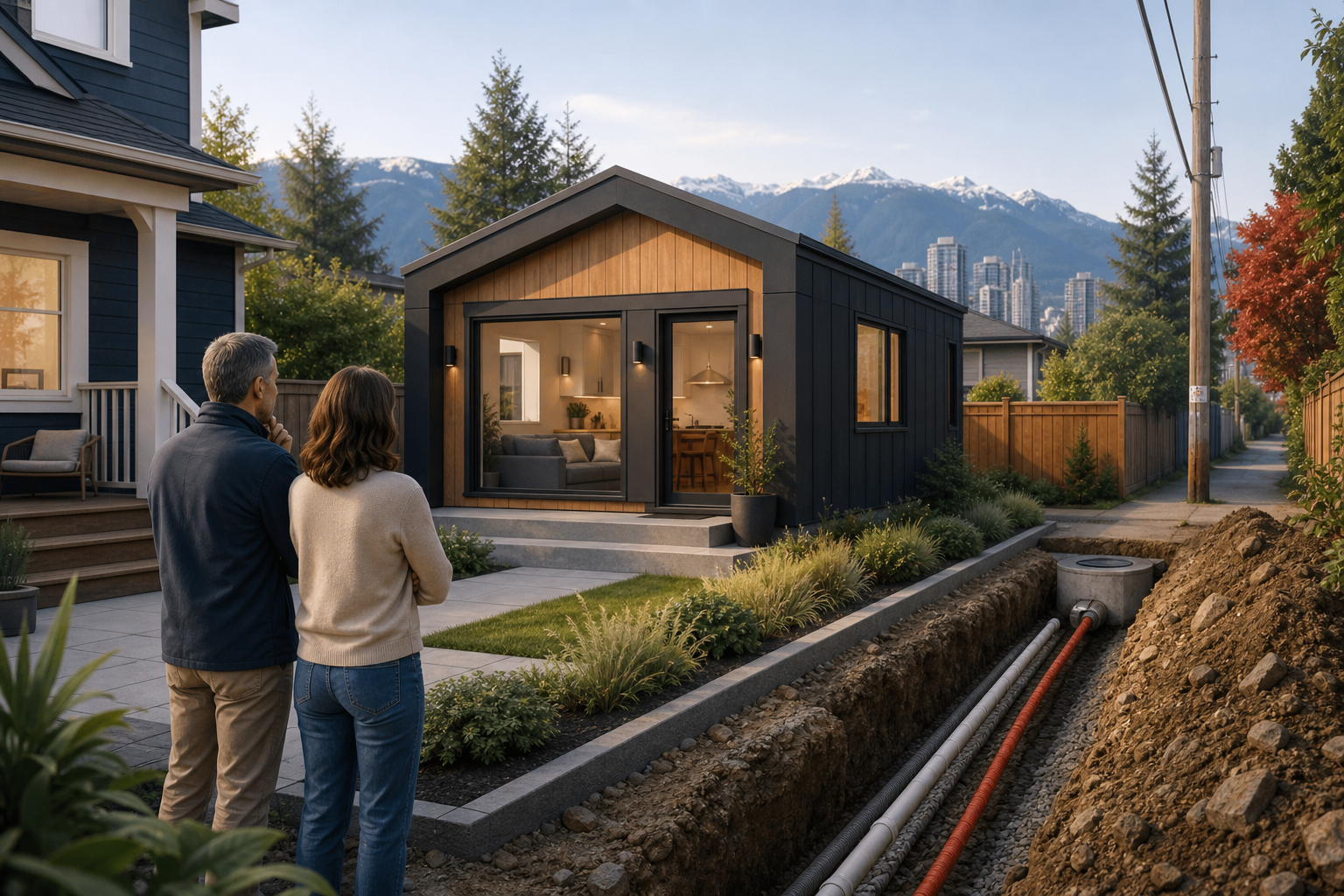

A couple in North Vancouver spent $485,000 building a 650-square-foot laneway suite in 2024. They now rent it for $2,900 per month. At that rate, they'll recover the construction cost in roughly 14 years, not counting property tax increases, maintenance, or the carrying cost of the capital they deployed. The income looks good. The math is harder.
The advertised promise of the laneway home is simple: build a detached unit in your backyard, rent it out, offset your mortgage or fund retirement. The $250,000 figure gets floated often in city planning documents and grant applications. It's real in the same way that "average Canadian salary" is real, accurate in aggregate, misleading in application. Actual builds in Vancouver, Toronto, and Calgary are running between $350,000 and $550,000 as of mid-2026, and the gap between that number and what you'll recover through rent or property value is where the decision gets interesting.
Where the $250K Estimate Breaks
The $250,000 baseline assumes a best-case scenario: a flat, accessible lot with existing service connections close to the build site, a simple rectangular footprint with standard finishes, and no utility trenching. Most lots don't meet all those conditions.
Start with services. Running water, sewer, and electrical from the street or main house to a detached structure costs $20,000 to $40,000 in most markets, and that's before you dig. If the lot slopes, add grading and possibly retaining walls. If the city requires a separate meter for the laneway unit, add another $8,000 to $12,000. If the alley access is narrow and equipment can't stage easily, labor hours inflate. These aren't edge cases, they're normal site conditions that don't appear in the planning-stage estimate.
Permit and design fees run $15,000 to $25,000, depending on the municipality. Toronto waives development charges for laneway suites, but you still pay for architectural drawings, structural engineering, and the surveyor's report. Vancouver caps fees but doesn't eliminate them. A basic permit package in Edmonton is cheaper than Toronto, but the timeline is longer, which adds carrying cost if you're financing construction with a HELOC at 7.2%.
Then finishes. A builder will quote you "builder-grade" at one price and "comparable to your main house" at another. The difference is $40,000 to $70,000 for a 600-square-foot unit. Most people building a laneway suite in 2026 are treating it as either a long-term rental asset or future housing for aging parents. Both cases push toward higher-end finishes, and the $250,000 estimate evaporates.
Rental Income: The High-End Scenario
Assume a two-bedroom, 600-square-foot laneway home in a high-demand urban market. In Vancouver, you can rent that for $2,800 to $3,500 per month as of mid-2026. In Toronto, $2,400 to $3,000. In Calgary, $1,800 to $2,200. Those numbers are gross, before vacancy, tenant turnover, property management if you're outsourcing it, and the incremental property tax hit from the reassessment.
Take the Toronto case. Build cost: $425,000 (realistic for a turnkey unit with mid-range finishes and typical trenching). Monthly rent: $2,600. Vacancy rate: assume 5%, or one month every 20 months. Net annual rent: $29,640. Property tax increase: roughly $1,800 per year. Maintenance reserve: $1,200 per year (this is conservative; replace it with real numbers after year three). Insurance delta: $600 per year for increased liability coverage. Net annual income: $26,040.
At $26,040 per year, you recover $425,000 in 16.3 years. That's before the opportunity cost of the capital. If you pulled $425,000 from a HELOC at 7.2%, your annual interest cost is $30,600, which is more than the net rent. You're subsidizing the tenant.
If you paid cash, the opportunity cost is what that $425,000 could have earned in an index fund, which over a 15-year horizon is roughly 5% real after inflation. You're giving up $21,250 per year in expected investment returns to earn $26,040 in rent, for a net $4,790 annual advantage. Over 15 years, that's $71,850 ahead of the index fund, plus you've added a rentable asset to your property. Not transformative, but positive.
Now the Vancouver case, where rent is higher. Same $425,000 build. Monthly rent: $3,200. Net annual income after the same deductions: $36,480. You're now $15,230 per year ahead of the index fund opportunity cost. Over 15 years: $228,450. That's where the laneway home starts to look like the right move, assuming rents hold and the unit doesn't sit vacant for extended stretches.
Property Value: The Appraisal Gap Problem
Adding a laneway suite increases your property's market value, but not always by the amount you spent. The gap depends on the neighborhood, the quality of the build, and whether comparable properties nearby have laneway units. In East Vancouver, where laneway homes are common, appraisers have comps and the value lift is reliable, often 60% to 80% of construction cost. In outer suburbs or markets where laneway units are new, appraisers struggle, and you might see only 40% to 50% of the build cost reflected in the appraised value.
If you're planning to sell within five years, the appraisal gap is a real loss. If you're holding the property long-term and treating the laneway unit as an income generator, the gap matters less. The rental income compounds, the mortgage on the main house gets paid down, and the laneway suite becomes part of a larger wealth-building strategy.
The "Switch" Strategy
The highest-return scenario isn't renting out the laneway home. It's moving into it yourself and renting out the main house.
A couple in their early 60s in Toronto owns a three-bedroom home worth $1.4 million, mortgage-free. They build a 600-square-foot laneway suite for $425,000, financed via HELOC. They move into the laneway unit. They rent the main house for $4,200 per month. Net annual rental income after expenses: $47,000. That income services the HELOC and funds their property taxes, leaving them with low fixed housing costs and the option to sell the main house later without sacrificing the lifestyle flexibility of staying in the neighborhood.
This only works if you're genuinely willing to downsize to 600 square feet, but for retirees who've already downsized mentally, it's a better financial outcome than renting out the smaller unit.
When the Recommendation Flips
Build the laneway home if: rental demand in your market can support $2,800+ per month, you're planning to hold the property for at least 10 years, and you can finance construction without monthly carrying costs that exceed the rental income. Don't build if: your market rents are soft, you're planning to sell within five years, or the construction cost exceeds $500,000 without a corresponding lift in either rent or property value.
The $250,000 figure is real only in theory. Plan for $425,000 to $475,000, and make the decision on those numbers.
Read Next
Canada's Big Six banks hit $37.5 billion in impaired loans, triple pre-pandemic levels
Your 2.5% Mortgage Rate and Ontario Divorce: 7 Ways to Keep or Share It
Fixed Mortgage Rates Climb as Bond Yields Erase Discount Room
Manulife One at 4.95% vs. Five-Year Fixed at 3.94%: The Shrinking Cash Flow Advantage