Advanced mortgage strategies from a twenty-year strategist. Written to help you pay off sooner, save more, and retire three to four times wealthier — without paying more each month.
Rent Down 4% in July: For Canadian Renters, 'Stabilizing' Still Means $2,037 a Month
A one-bedroom in Toronto still commands roughly $2,400. Vancouver exceeds $2,600. The fact that these figures represent a cooling from last year's frenzy doesn't make them tolerable, it makes them slightly less intolerable.
The national average asking rent dropped 4% year-over-year in July 2026, landing at $2,037. Market watchers are calling this "stabilization." That word does a lot of work. It suggests equilibrium, a return to normal operating conditions, relief. What it actually describes is a market where the bidding wars have stopped but the underlying crisis hasn't.
The decline tells you where the heat was artificial
The sharpest drops are showing up in secondary markets that saw the most irrational spikes during the 2021-2023 window, college towns bloated by international student arrivals, suburban nodes where investors bought preconstruction condos assuming infinite demand. Those places are correcting because the federal government capped international student permits and because purpose-built rental projects started in 2021 are finally delivering units.
But core urban centers are holding. Toronto and Vancouver vacancy rates remain near historic lows despite the headline decline. CMHC data shows asking rents falling while actual vacancy barely budges. That gap matters. It means the inventory problem isn't solved, it's just not getting demonstrably worse at the moment.
Stabilization doesn't help the 70% who aren't moving
Asking rent figures track vacant units listed for new tenants. They tell you nothing about what sitting renters are paying. Under provincial rent control regimes, a tenant in a $1,400 unit isn't benefiting from the fact that the building next door is now asking $2,000 instead of $2,100. The golden handcuffs are real: move and you reset to market rates. Stay and you're stuck in place, unable to relocate for work, unable to upgrade to a second bedroom when a kid arrives.
This creates a two-tier rental class. New arrivals and anyone forced to move face the "stabilized" $2,037 average. Long-term tenants sit $500 to $800 below that, locked into units they can't afford to leave. The market isn't stabilizing for them. It's calcifying.
The condo-rental market is where the real stress sits
Purpose-built rentals are stabilizing because they were designed to be rentals, institutions own them, they were underwritten at realistic yields, and they don't panic. The condo-rental segment is different. Individual investors who bought at 1.79% in 2021 and are now carrying at 5.4% are bleeding monthly. They can't raise rents fast enough to cover the gap without violating rent control, and they can't sell into a soft resale market without taking a loss.
Some are offering incentives, one month free, reduced deposits, to attract stable tenants and avoid vacancy. That's new. For three years, landlords had the leverage. Now, in select suburban markets, tenants do. Barely. The shift is marginal but directional.
What 4% down actually buys you
If you're spending 50% of your income on rent, a 4% decline saves you $80 a month on a $2,000 unit. That's two grocery trips. It doesn't move the affordability needle. It doesn't change the fact that median rents are still running 30% above pre-pandemic levels in most major markets.
The Bank of Canada has started cutting rates in mid-2026, but mortgage qualifying rules remain tight enough that most renters can't convert to ownership even if they wanted to. They're stuck in the rental pool, and the rental pool remains expensive relative to income. The national unemployment rate has ticked up to roughly 6.5%, which has reduced mobility and application volume, but it hasn't crashed demand.
Stabilization, in this context, means the market stopped accelerating. It doesn't mean it reversed. The average asking rent is still historically high, vacancy is still historically low, and affordability is still historically broken. The crisis didn't end. It just stopped getting worse at the same pace.


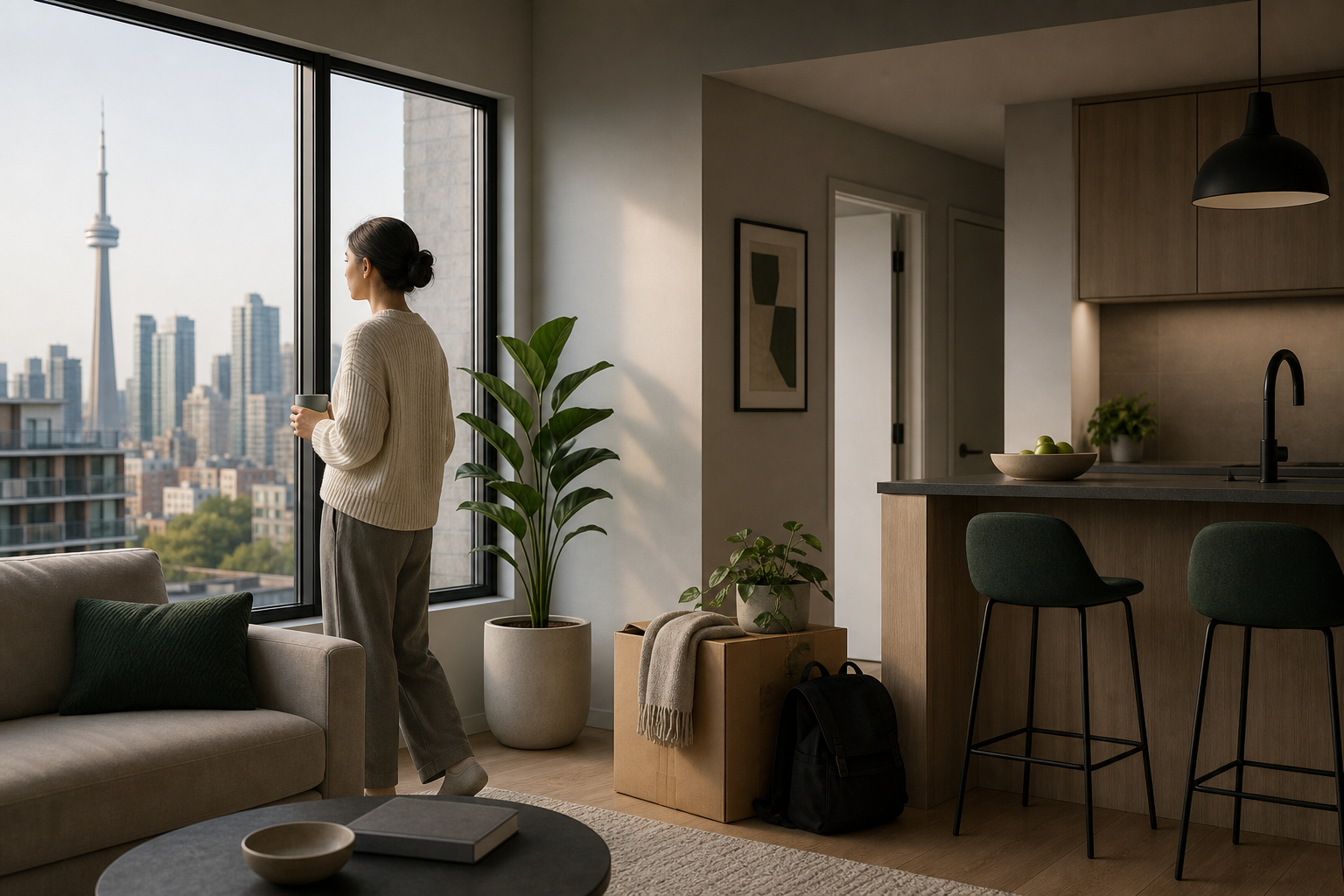

A one-bedroom in Toronto still commands roughly $2,400. Vancouver exceeds $2,600. The fact that these figures represent a cooling from last year's frenzy doesn't make them tolerable, it makes them slightly less intolerable.
The national average asking rent dropped 4% year-over-year in July 2026, landing at $2,037. Market watchers are calling this "stabilization." That word does a lot of work. It suggests equilibrium, a return to normal operating conditions, relief. What it actually describes is a market where the bidding wars have stopped but the underlying crisis hasn't.
The decline tells you where the heat was artificial
The sharpest drops are showing up in secondary markets that saw the most irrational spikes during the 2021-2023 window, college towns bloated by international student arrivals, suburban nodes where investors bought preconstruction condos assuming infinite demand. Those places are correcting because the federal government capped international student permits and because purpose-built rental projects started in 2021 are finally delivering units.
But core urban centers are holding. Toronto and Vancouver vacancy rates remain near historic lows despite the headline decline. CMHC data shows asking rents falling while actual vacancy barely budges. That gap matters. It means the inventory problem isn't solved, it's just not getting demonstrably worse at the moment.
Stabilization doesn't help the 70% who aren't moving
Asking rent figures track vacant units listed for new tenants. They tell you nothing about what sitting renters are paying. Under provincial rent control regimes, a tenant in a $1,400 unit isn't benefiting from the fact that the building next door is now asking $2,000 instead of $2,100. The golden handcuffs are real: move and you reset to market rates. Stay and you're stuck in place, unable to relocate for work, unable to upgrade to a second bedroom when a kid arrives.
This creates a two-tier rental class. New arrivals and anyone forced to move face the "stabilized" $2,037 average. Long-term tenants sit $500 to $800 below that, locked into units they can't afford to leave. The market isn't stabilizing for them. It's calcifying.
The condo-rental market is where the real stress sits
Purpose-built rentals are stabilizing because they were designed to be rentals, institutions own them, they were underwritten at realistic yields, and they don't panic. The condo-rental segment is different. Individual investors who bought at 1.79% in 2021 and are now carrying at 5.4% are bleeding monthly. They can't raise rents fast enough to cover the gap without violating rent control, and they can't sell into a soft resale market without taking a loss.
Some are offering incentives, one month free, reduced deposits, to attract stable tenants and avoid vacancy. That's new. For three years, landlords had the leverage. Now, in select suburban markets, tenants do. Barely. The shift is marginal but directional.
What 4% down actually buys you
If you're spending 50% of your income on rent, a 4% decline saves you $80 a month on a $2,000 unit. That's two grocery trips. It doesn't move the affordability needle. It doesn't change the fact that median rents are still running 30% above pre-pandemic levels in most major markets.
The Bank of Canada has started cutting rates in mid-2026, but mortgage qualifying rules remain tight enough that most renters can't convert to ownership even if they wanted to. They're stuck in the rental pool, and the rental pool remains expensive relative to income. The national unemployment rate has ticked up to roughly 6.5%, which has reduced mobility and application volume, but it hasn't crashed demand.
Stabilization, in this context, means the market stopped accelerating. It doesn't mean it reversed. The average asking rent is still historically high, vacancy is still historically low, and affordability is still historically broken. The crisis didn't end. It just stopped getting worse at the same pace.
Read Next
Canada's Big Six banks hit $37.5 billion in impaired loans, triple pre-pandemic levels
Your 2.5% Mortgage Rate and Ontario Divorce: 7 Ways to Keep or Share It
Fixed Mortgage Rates Climb as Bond Yields Erase Discount Room
Manulife One at 4.95% vs. Five-Year Fixed at 3.94%: The Shrinking Cash Flow Advantage