Advanced mortgage strategies from a twenty-year strategist. Written to help you pay off sooner, save more, and retire three to four times wealthier — without paying more each month.
Student Tenant Insurance in Canada: Why $15/Month Covers $2,000+ in Dorm Disasters
A laptop, smartphone, tablet, and noise-canceling headphones sit in a backpack worth roughly $4,200. That's the average tech load a Canadian university student carries to a single lecture in 2026. Lose the bag to theft and you're out a semester's earnings before you've written the first midterm.
Most students moving into off-campus housing this fall will sign a lease that includes a clause they've never seen before: proof of tenant insurance required before key handover. What used to be a "nice to have" is now standard in Toronto, Vancouver, Montreal, and increasingly in second-tier university towns where landlords are tightening risk management.
The policy costs $15 to $30 a month. The question isn't whether it's affordable. The question is whether students understand what they're actually buying, and whether it covers the disasters that matter.
The coverage everyone buys for the wrong reason
Student tenant insurance is marketed around contents coverage, the $2,000 laptop replacement scenario. That's real, but it's not the highest-value protection in the policy.
The component that prevents actual financial catastrophe is liability. If you leave a candle burning and the resulting fire damages three neighboring units, you're personally liable. Canadian courts have upheld six-figure judgments against tenants whose negligence caused building-wide damage. A standard student policy includes $1 million in personal liability coverage, which pays for legal defense and settlements.
The second underrated line is Additional Living Expenses (ALE). If your apartment becomes uninhabitable due to fire, flood, or structural failure, ALE covers hotel stays and meals until you can move back in or find alternative housing. For a student with no credit card float and no family nearby, this is the difference between finishing the semester and withdrawing.
Contents coverage matters, but it's the least differentiated part of the policy. Most carriers cap personal belongings at $30,000, which is far above what a typical student owns. The real gap shows up in sub-limits: jewelry might be capped at $1,000, bicycles at $1,000, and cash at $200. Students who own a $3,500 e-bike or expensive instruments need to add a rider, which raises the premium.
The parental policy trap
Many students assume they're covered under their parents' homeowner's insurance. That's sometimes true. If the student is living away temporarily for school and the parents still claim them as a dependent, some policies extend contents coverage to the student's dorm room or apartment.
But relying on this creates two problems. First, not all homeowner policies include this extension, and the ones that do often have restrictive terms, coverage might apply only to on-campus housing, or only to belongings stored at the student's "primary residence" (the parents' home).
Second, if the student makes a claim, it goes on the parents' insurance record. A $2,000 claim for a stolen laptop can trigger a premium increase on the family's entire home policy, sometimes costing more over three years than a standalone student policy would have cost.
The safer route: the student buys their own policy. At $20 a month, it's cheaper than one restaurant meal and eliminates the risk of contaminating the parents' claims history.
The roommate problem
Students sharing an apartment often ask whether they can split one policy. The answer is technically yes, but it's almost never advised.
When multiple people are named on a single policy, a claim by one person affects everyone. If your roommate files a liability claim because they accidentally caused water damage, that claim stays on your insurance record when you apply for auto or home insurance later. You also lose control: your roommate can make claims without your knowledge, and you're jointly responsible for premium increases or cancellation.
Each roommate should carry their own policy. Most insurers price student tenant insurance by the individual, not by the unit.
What actually triggers a $2,000+ payout
The theft scenario is real but uncommon. The payouts that routinely clear $2,000 come from water damage and fire.
A burst pipe in winter can destroy furniture, textbooks, electronics, and clothing in one event. Even a minor kitchen fire renders most soft goods unusable due to smoke. Students underestimate how much it costs to replace everything at once: a bed frame, desk, winter coat, boots, all course materials, kitchenware. The out-of-pocket to restart from zero is closer to $5,000 than $2,000.
The deductible matters here. Most student policies have a $500 to $1,000 deductible. A $1,200 laptop theft might not be worth claiming after the deductible. A $4,500 total loss from a flood is.
Before buying, confirm the deductible and decide whether you'd actually file a claim for anything under $1,500. If not, you're really buying liability and ALE protection, and the contents coverage is secondary.
The one thing most students skip is reading the policy's negligence exclusions. Damage caused by a party that violates the lease or local noise bylaws may not be covered. Neither is intentional damage. The policy protects you from accidents, not from poor judgment.


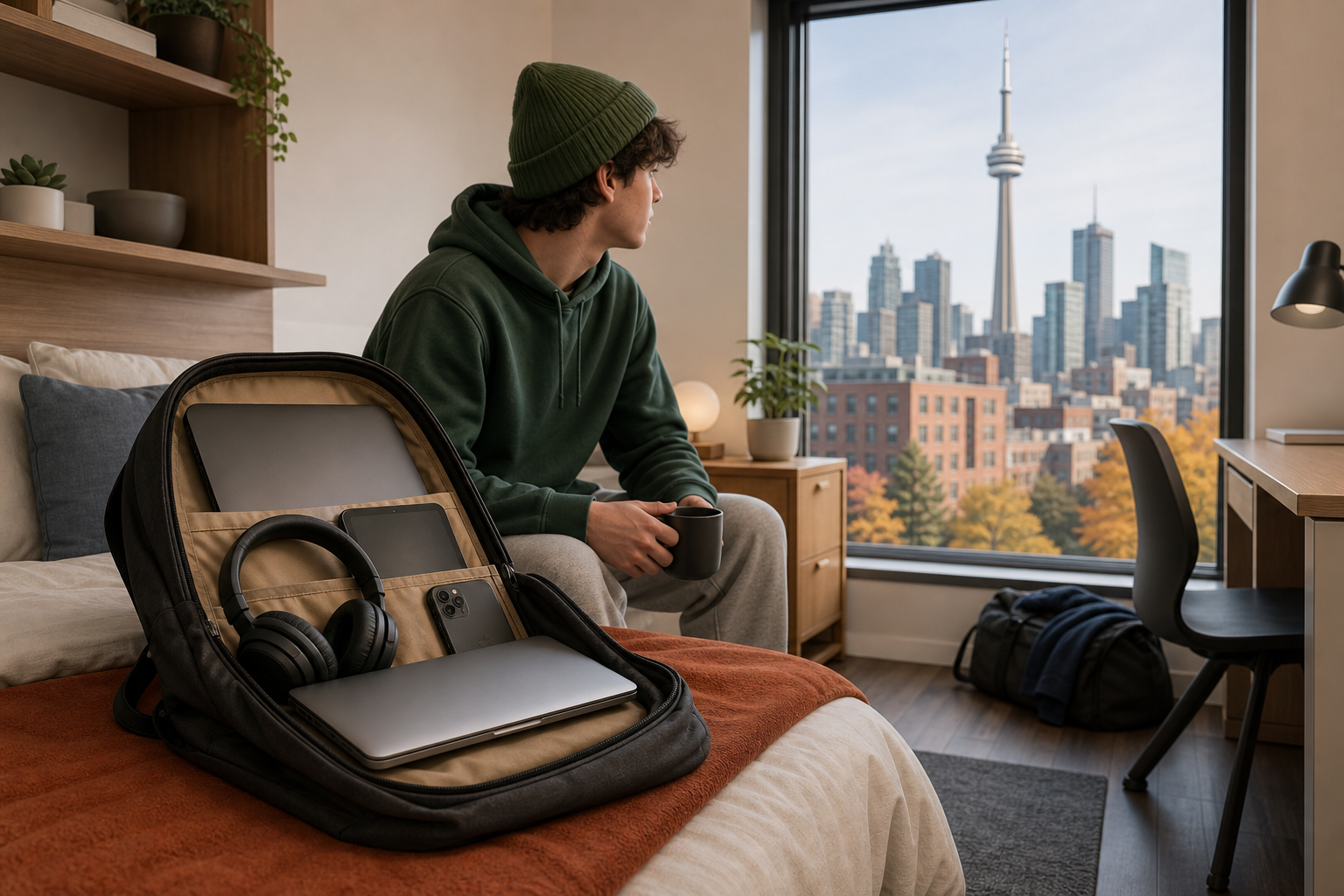

A laptop, smartphone, tablet, and noise-canceling headphones sit in a backpack worth roughly $4,200. That's the average tech load a Canadian university student carries to a single lecture in 2026. Lose the bag to theft and you're out a semester's earnings before you've written the first midterm.
Most students moving into off-campus housing this fall will sign a lease that includes a clause they've never seen before: proof of tenant insurance required before key handover. What used to be a "nice to have" is now standard in Toronto, Vancouver, Montreal, and increasingly in second-tier university towns where landlords are tightening risk management.
The policy costs $15 to $30 a month. The question isn't whether it's affordable. The question is whether students understand what they're actually buying, and whether it covers the disasters that matter.
The coverage everyone buys for the wrong reason
Student tenant insurance is marketed around contents coverage, the $2,000 laptop replacement scenario. That's real, but it's not the highest-value protection in the policy.
The component that prevents actual financial catastrophe is liability. If you leave a candle burning and the resulting fire damages three neighboring units, you're personally liable. Canadian courts have upheld six-figure judgments against tenants whose negligence caused building-wide damage. A standard student policy includes $1 million in personal liability coverage, which pays for legal defense and settlements.
The second underrated line is Additional Living Expenses (ALE). If your apartment becomes uninhabitable due to fire, flood, or structural failure, ALE covers hotel stays and meals until you can move back in or find alternative housing. For a student with no credit card float and no family nearby, this is the difference between finishing the semester and withdrawing.
Contents coverage matters, but it's the least differentiated part of the policy. Most carriers cap personal belongings at $30,000, which is far above what a typical student owns. The real gap shows up in sub-limits: jewelry might be capped at $1,000, bicycles at $1,000, and cash at $200. Students who own a $3,500 e-bike or expensive instruments need to add a rider, which raises the premium.
The parental policy trap
Many students assume they're covered under their parents' homeowner's insurance. That's sometimes true. If the student is living away temporarily for school and the parents still claim them as a dependent, some policies extend contents coverage to the student's dorm room or apartment.
But relying on this creates two problems. First, not all homeowner policies include this extension, and the ones that do often have restrictive terms, coverage might apply only to on-campus housing, or only to belongings stored at the student's "primary residence" (the parents' home).
Second, if the student makes a claim, it goes on the parents' insurance record. A $2,000 claim for a stolen laptop can trigger a premium increase on the family's entire home policy, sometimes costing more over three years than a standalone student policy would have cost.
The safer route: the student buys their own policy. At $20 a month, it's cheaper than one restaurant meal and eliminates the risk of contaminating the parents' claims history.
The roommate problem
Students sharing an apartment often ask whether they can split one policy. The answer is technically yes, but it's almost never advised.
When multiple people are named on a single policy, a claim by one person affects everyone. If your roommate files a liability claim because they accidentally caused water damage, that claim stays on your insurance record when you apply for auto or home insurance later. You also lose control: your roommate can make claims without your knowledge, and you're jointly responsible for premium increases or cancellation.
Each roommate should carry their own policy. Most insurers price student tenant insurance by the individual, not by the unit.
What actually triggers a $2,000+ payout
The theft scenario is real but uncommon. The payouts that routinely clear $2,000 come from water damage and fire.
A burst pipe in winter can destroy furniture, textbooks, electronics, and clothing in one event. Even a minor kitchen fire renders most soft goods unusable due to smoke. Students underestimate how much it costs to replace everything at once: a bed frame, desk, winter coat, boots, all course materials, kitchenware. The out-of-pocket to restart from zero is closer to $5,000 than $2,000.
The deductible matters here. Most student policies have a $500 to $1,000 deductible. A $1,200 laptop theft might not be worth claiming after the deductible. A $4,500 total loss from a flood is.
Before buying, confirm the deductible and decide whether you'd actually file a claim for anything under $1,500. If not, you're really buying liability and ALE protection, and the contents coverage is secondary.
The one thing most students skip is reading the policy's negligence exclusions. Damage caused by a party that violates the lease or local noise bylaws may not be covered. Neither is intentional damage. The policy protects you from accidents, not from poor judgment.
Read Next
Canada's Big Six banks hit $37.5 billion in impaired loans, triple pre-pandemic levels
Your 2.5% Mortgage Rate and Ontario Divorce: 7 Ways to Keep or Share It
Fixed Mortgage Rates Climb as Bond Yields Erase Discount Room
Manulife One at 4.95% vs. Five-Year Fixed at 3.94%: The Shrinking Cash Flow Advantage