Advanced mortgage strategies from a twenty-year strategist. Written to help you pay off sooner, save more, and retire three to four times wealthier — without paying more each month.
The Detective Border: How AI Tariff Enforcement Creates More Problems Than It Solves
The Trump administration is feeding Customs and Border Protection (CBP) machine learning models trained on shipping manifests, satellite imagery, and bill of lading data to flag anomalies in global trade flows. The goal is to stop Chinese manufacturers from routing goods through Vietnam, Mexico, and Malaysia to dodge Section 301 tariffs that now reach as high as 100% on certain categories. The system is designed to identify transshipment patterns and "phoenix companies" that dissolve and reappear under new names to evade enforcement.
The technology treats the border as a prediction problem rather than a checkpoint. Traditional enforcement relied on audits after the fact, catching violations months or years later when the goods were already sold and the importer had restructured. AI shifts this to the port of entry, stopping shipments in real time based on probabilistic flags. If a container's paperwork claims Vietnamese steel but the shipping route, the exporter's registration date, and the volume spike all suggest Chinese origin, the system flags it for inspection before it clears customs.
This sounds efficient until you consider what the model is actually doing. It is predicting fraud based on patterns that correlate with fraud in past data. That data includes legitimate shipments that happened to share features with fraudulent ones. A small Vietnamese manufacturer that expanded rapidly after 2025, ships through the same ports as transshippers, and uses similar freight forwarders will produce the same signal as a shell company. The system cannot tell the difference at the algorithmic level. It can only assign a risk score.
Why the Feedback Loop Breaks Down
The enforcement model depends on CBP agents reviewing flagged shipments and making final determinations. In practice, the volume is too high. CBP processed over 1 billion packages under the de minimis threshold in 2024 alone, most with minimal accompanying data. When the system flags 8% of inbound containers for manual review, the agency does not have the staff to investigate all of them thoroughly. The predictable outcome is that agents default to the algorithm's recommendation. If the score is high, the shipment gets seized or delayed. If it is borderline, it clears.
This creates two problems. First, the model's errors compound. A false positive that delays a legitimate shipment does not get recorded as a mistake unless the importer appeals and wins, which costs time and legal fees most small businesses cannot afford. The model treats the lack of appeal as confirmation that the flag was correct, and the pattern that triggered it gets reinforced in the next training cycle.
Second, exporters adapt. Sophisticated transshippers are already using their own machine learning to identify which shipping routes, documentation patterns, and corporate structures the CBP model treats as low risk. The result is an adversarial optimization problem where both sides are training algorithms against each other. The exporters have an advantage: they can test strategies in real time by sending small shipments and observing which ones clear. CBP's model, by contrast, updates on a slower cycle and has to balance false positives against the political cost of letting fraud through.
What Gets Sacrificed for Speed
The administration frames this as a way to protect domestic manufacturing, and in theory, better enforcement should reduce the advantage that tariff dodgers have over compliant producers. But the system's design creates a tradeoff that runs the other way. Trusted traders with clean records still get caught in the dragnet because the model is optimizing for recall, not precision. It would rather flag ten legitimate shipments than miss one fraudulent one.
That cost lands unevenly. A Fortune 500 importer has customs brokers, legal staff, and the margin to absorb delays. A regional distributor buying components from a new supplier in Southeast Asia does not. The effect is to raise the compliance cost for smaller players disproportionately, which entrenches the market position of the largest importers who can afford to navigate an AI-enforced border.
The deeper issue is that the system treats a structural problem as a detection problem. Transshipment exists because the tariff differential between Chinese and non-Chinese goods is large enough to justify the cost of rerouting. As long as that gap persists, exporters will find ways to exploit it. Deploying better detection just raises the sophistication required to evade, which locks out smaller bad actors but leaves the well-resourced ones in the game.


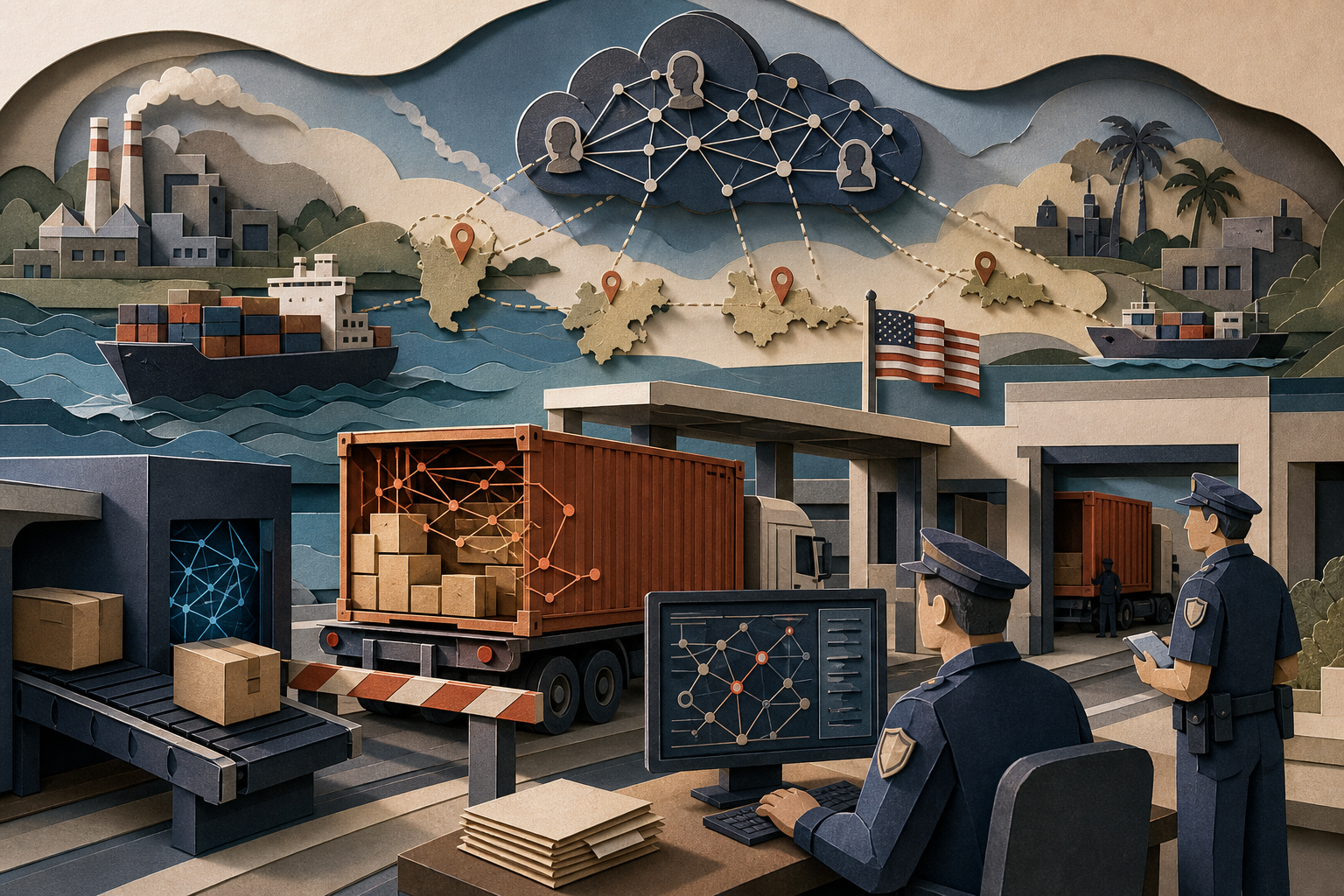

The Trump administration is feeding Customs and Border Protection (CBP) machine learning models trained on shipping manifests, satellite imagery, and bill of lading data to flag anomalies in global trade flows. The goal is to stop Chinese manufacturers from routing goods through Vietnam, Mexico, and Malaysia to dodge Section 301 tariffs that now reach as high as 100% on certain categories. The system is designed to identify transshipment patterns and "phoenix companies" that dissolve and reappear under new names to evade enforcement.
The technology treats the border as a prediction problem rather than a checkpoint. Traditional enforcement relied on audits after the fact, catching violations months or years later when the goods were already sold and the importer had restructured. AI shifts this to the port of entry, stopping shipments in real time based on probabilistic flags. If a container's paperwork claims Vietnamese steel but the shipping route, the exporter's registration date, and the volume spike all suggest Chinese origin, the system flags it for inspection before it clears customs.
This sounds efficient until you consider what the model is actually doing. It is predicting fraud based on patterns that correlate with fraud in past data. That data includes legitimate shipments that happened to share features with fraudulent ones. A small Vietnamese manufacturer that expanded rapidly after 2025, ships through the same ports as transshippers, and uses similar freight forwarders will produce the same signal as a shell company. The system cannot tell the difference at the algorithmic level. It can only assign a risk score.
Why the Feedback Loop Breaks Down
The enforcement model depends on CBP agents reviewing flagged shipments and making final determinations. In practice, the volume is too high. CBP processed over 1 billion packages under the de minimis threshold in 2024 alone, most with minimal accompanying data. When the system flags 8% of inbound containers for manual review, the agency does not have the staff to investigate all of them thoroughly. The predictable outcome is that agents default to the algorithm's recommendation. If the score is high, the shipment gets seized or delayed. If it is borderline, it clears.
This creates two problems. First, the model's errors compound. A false positive that delays a legitimate shipment does not get recorded as a mistake unless the importer appeals and wins, which costs time and legal fees most small businesses cannot afford. The model treats the lack of appeal as confirmation that the flag was correct, and the pattern that triggered it gets reinforced in the next training cycle.
Second, exporters adapt. Sophisticated transshippers are already using their own machine learning to identify which shipping routes, documentation patterns, and corporate structures the CBP model treats as low risk. The result is an adversarial optimization problem where both sides are training algorithms against each other. The exporters have an advantage: they can test strategies in real time by sending small shipments and observing which ones clear. CBP's model, by contrast, updates on a slower cycle and has to balance false positives against the political cost of letting fraud through.
What Gets Sacrificed for Speed
The administration frames this as a way to protect domestic manufacturing, and in theory, better enforcement should reduce the advantage that tariff dodgers have over compliant producers. But the system's design creates a tradeoff that runs the other way. Trusted traders with clean records still get caught in the dragnet because the model is optimizing for recall, not precision. It would rather flag ten legitimate shipments than miss one fraudulent one.
That cost lands unevenly. A Fortune 500 importer has customs brokers, legal staff, and the margin to absorb delays. A regional distributor buying components from a new supplier in Southeast Asia does not. The effect is to raise the compliance cost for smaller players disproportionately, which entrenches the market position of the largest importers who can afford to navigate an AI-enforced border.
The deeper issue is that the system treats a structural problem as a detection problem. Transshipment exists because the tariff differential between Chinese and non-Chinese goods is large enough to justify the cost of rerouting. As long as that gap persists, exporters will find ways to exploit it. Deploying better detection just raises the sophistication required to evade, which locks out smaller bad actors but leaves the well-resourced ones in the game.
Read Next
Canada's Big Six banks hit $37.5 billion in impaired loans, triple pre-pandemic levels
Your 2.5% Mortgage Rate and Ontario Divorce: 7 Ways to Keep or Share It
Fixed Mortgage Rates Climb as Bond Yields Erase Discount Room
Manulife One at 4.95% vs. Five-Year Fixed at 3.94%: The Shrinking Cash Flow Advantage