Advanced mortgage strategies from a twenty-year strategist. Written to help you pay off sooner, save more, and retire three to four times wealthier — without paying more each month.
The Vic Towns placed under creditor protection with 65 unsold townhouses in North York
Solotex Group finished The Vic Towns in 2024. All 147 units were built. The roads were paved. The electrical hookups were live. And 65 townhouses sat empty, not because construction had stalled but because nobody would buy them.
The developer filed for creditor protection that year. The project sits at 1648 Victoria Park Avenue, a few blocks from Eglinton Square Shopping Centre, in what was supposed to be the next wave of North York density. The Eglinton Crosstown LRT was meant to turn this stretch of Victoria Park into a transit-premium corridor. Families priced out of Leaside freehold stock were supposed to see these stacked townhouses as the middle ground between a $1.4 million detached and a two-bedroom condo with maintenance fees running $650 a month.
The math didn't work. Not because the units were bad. The finishes were market-standard. The layouts made sense for young families. But the gap between what the developer needed to clear and what buyers could qualify for at mid-2024 mortgage rates was about $110,000 per unit, and nobody bridged it.
The Inventory Paradox
This is the opposite problem from the one Toronto spent a decade complaining about. For years, the crisis was described as undersupply. Developers couldn't build fast enough. Prices climbed because finished units were absorbed faster than they could be delivered. The Vic Towns represents the flip: a project that is physically complete but financially broken. The building exists. The demand, in the form of mortgage-qualified buyers willing to pay the listed price, does not.
Urbanation's 2024 data on the GTA showed new townhouse and condo sales hitting multi-decade lows. Developers who had pre-sold 70% of their units during the application phase were finishing projects in a market where the remaining 30% had no takers. At The Vic, that unsold fraction was 44%. Nearly half the project sat vacant while the developer carried the cost of completion with no revenue to offset it.
The interest rate environment made the problem worse. Solotex Group, like most mid-sized developers, likely carried floating-rate construction debt. When the Bank of Canada held rates in the 4.5% to 5% range through most of 2024, the monthly cost of servicing that debt became a fixed burn with no corresponding sales to cover it. Even after the central bank began cutting in mid-2024, the damage was structural. Buyers who might have qualified at 2.5% in 2021 were now running stress-test calculations at effective rates above 7%. The mortgage they could carry dropped by roughly $150,000 in purchasing power. The developer's ask did not.
What Creditor Protection Actually Does
Filing under the Companies' Creditors Arrangement Act freezes litigation and foreclosure while the court appoints a monitor to oversee a restructuring or sale. It does not mean the project disappears. More often, it means a new manager steps in, takes control of the remaining inventory, and liquidates it at whatever price clears the market. For buyers, that can mean discounts of 15% to 25% off the original list. For the developer, it means taking a loss but exiting the liability. For lenders, it means recovering a fraction of the debt rather than taking full ownership of a half-empty building.
The Eglinton Crosstown LRT still hasn't opened reliably. The original promise that drove pricing in this corridor, fast, frequent transit to Yonge Street and beyond, remains theoretical. Developers who underwrote these projects in 2019 and 2020 priced in a transit premium that buyers are no longer willing to pay. They are waiting for the trains to actually run.
The Vic Towns will likely sell. Just not at the number Solotex needed. Someone will buy the remaining 65 units, possibly as rental stock, possibly as discounted starter homes for families who can finally afford the entry point. The project won't be demolished. But the lesson is already visible: finishing the building is not the same as finishing the deal. And in a market where rates moved faster than absorption, the gap between those two things can be wide enough to break a developer entirely.


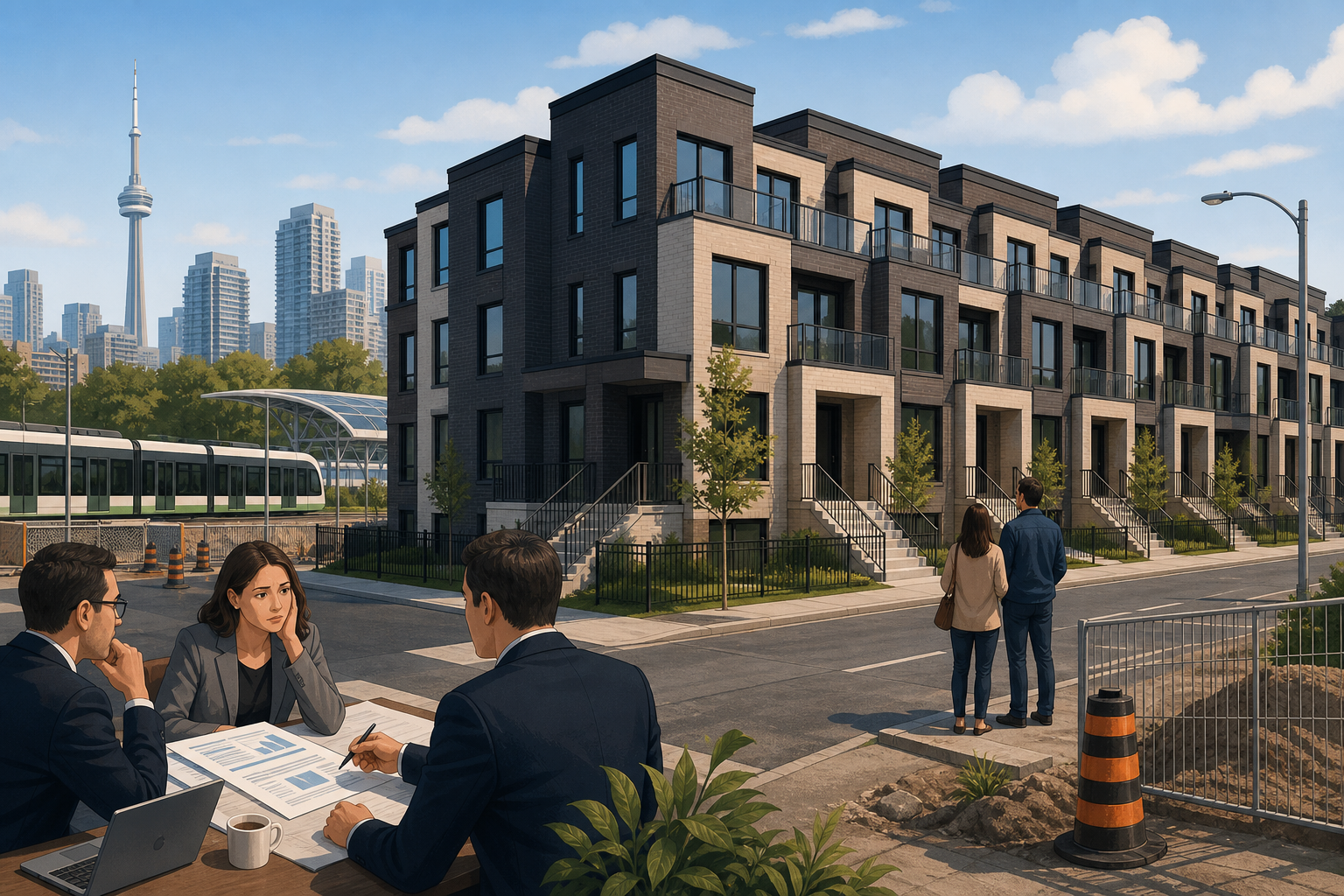

Solotex Group finished The Vic Towns in 2024. All 147 units were built. The roads were paved. The electrical hookups were live. And 65 townhouses sat empty, not because construction had stalled but because nobody would buy them.
The developer filed for creditor protection that year. The project sits at 1648 Victoria Park Avenue, a few blocks from Eglinton Square Shopping Centre, in what was supposed to be the next wave of North York density. The Eglinton Crosstown LRT was meant to turn this stretch of Victoria Park into a transit-premium corridor. Families priced out of Leaside freehold stock were supposed to see these stacked townhouses as the middle ground between a $1.4 million detached and a two-bedroom condo with maintenance fees running $650 a month.
The math didn't work. Not because the units were bad. The finishes were market-standard. The layouts made sense for young families. But the gap between what the developer needed to clear and what buyers could qualify for at mid-2024 mortgage rates was about $110,000 per unit, and nobody bridged it.
The Inventory Paradox
This is the opposite problem from the one Toronto spent a decade complaining about. For years, the crisis was described as undersupply. Developers couldn't build fast enough. Prices climbed because finished units were absorbed faster than they could be delivered. The Vic Towns represents the flip: a project that is physically complete but financially broken. The building exists. The demand, in the form of mortgage-qualified buyers willing to pay the listed price, does not.
Urbanation's 2024 data on the GTA showed new townhouse and condo sales hitting multi-decade lows. Developers who had pre-sold 70% of their units during the application phase were finishing projects in a market where the remaining 30% had no takers. At The Vic, that unsold fraction was 44%. Nearly half the project sat vacant while the developer carried the cost of completion with no revenue to offset it.
The interest rate environment made the problem worse. Solotex Group, like most mid-sized developers, likely carried floating-rate construction debt. When the Bank of Canada held rates in the 4.5% to 5% range through most of 2024, the monthly cost of servicing that debt became a fixed burn with no corresponding sales to cover it. Even after the central bank began cutting in mid-2024, the damage was structural. Buyers who might have qualified at 2.5% in 2021 were now running stress-test calculations at effective rates above 7%. The mortgage they could carry dropped by roughly $150,000 in purchasing power. The developer's ask did not.
What Creditor Protection Actually Does
Filing under the Companies' Creditors Arrangement Act freezes litigation and foreclosure while the court appoints a monitor to oversee a restructuring or sale. It does not mean the project disappears. More often, it means a new manager steps in, takes control of the remaining inventory, and liquidates it at whatever price clears the market. For buyers, that can mean discounts of 15% to 25% off the original list. For the developer, it means taking a loss but exiting the liability. For lenders, it means recovering a fraction of the debt rather than taking full ownership of a half-empty building.
The Eglinton Crosstown LRT still hasn't opened reliably. The original promise that drove pricing in this corridor, fast, frequent transit to Yonge Street and beyond, remains theoretical. Developers who underwrote these projects in 2019 and 2020 priced in a transit premium that buyers are no longer willing to pay. They are waiting for the trains to actually run.
The Vic Towns will likely sell. Just not at the number Solotex needed. Someone will buy the remaining 65 units, possibly as rental stock, possibly as discounted starter homes for families who can finally afford the entry point. The project won't be demolished. But the lesson is already visible: finishing the building is not the same as finishing the deal. And in a market where rates moved faster than absorption, the gap between those two things can be wide enough to break a developer entirely.
Read Next
Canada's Big Six banks hit $37.5 billion in impaired loans, triple pre-pandemic levels
Your 2.5% Mortgage Rate and Ontario Divorce: 7 Ways to Keep or Share It
Fixed Mortgage Rates Climb as Bond Yields Erase Discount Room
Manulife One at 4.95% vs. Five-Year Fixed at 3.94%: The Shrinking Cash Flow Advantage