Advanced mortgage strategies from a twenty-year strategist. Written to help you pay off sooner, save more, and retire three to four times wealthier — without paying more each month.
Trump Sells Tariffs in Michigan While the State's Biggest Trade Partner Absorbs the Hit
The Gordie Howe International Bridge opened to traffic in early 2026 with almost no ceremony, a $6 billion crossing that was supposed to symbolize North American integration now standing as a monument to its opposite. The physical infrastructure is complete. The political willingness to use it is not.
Canada remains Michigan's largest export market, absorbing roughly $80 billion in two-way trade annually. That trade supports hundreds of thousands of Michigan jobs, most of them concentrated in automotive manufacturing corridors where a single component might cross the Ambassador Bridge or the new Gordie Howe span seven times during assembly. Each crossing now carries a tariff. The cumulative effect is not marginal, industry analysts estimate production costs per vehicle could rise by more than $2,500 if the administration's proposed reciprocal tariffs are fully implemented.
The administration's position is straightforward: tariffs protect domestic steel and aluminum producers, industries flagged as national security priorities under Section 232. The current rate on certain imported steel sits at 25 percent, with Canadian aluminum facing a 10 percent baseline duty. These are not symbolic figures. They represent a direct tax on Michigan's tool-and-die shops, parts suppliers, and stamping facilities, the downstream users who consume imported raw materials and employ far more people than the primary metal producers the tariffs are designed to protect.
The Infrastructure Paradox
We are building faster highways to slow down commerce. The Gordie Howe Bridge was funded in part by the federal government, approved by both parties, and constructed to reduce bottlenecks at the Ambassador crossing. That engineering achievement now coexists with a regulatory regime that makes moving goods across it more expensive than it was five years ago. The bridge clears the physical path. The tariffs narrow the economic one.
This is not an accident of timing. The administration views tariffs as both a trade lever and a revenue stream, a way to offset domestic tax cuts while pressuring trading partners into bilateral concessions. Michigan is the testing ground for whether that theory holds when your largest customer is also your closest ally.
Who Actually Pays
Proponents argue that high tariffs are the only mechanism powerful enough to force automotive supply chains out of Asia and back into the Great Lakes region. That logic treats Canada as part of the problem rather than the solution, a confusion that costs Michigan workers twice: once when tariffs raise their input costs, and again when Canada retaliates by targeting Michigan-specific exports like agricultural products and furniture.
The downstream casualties outnumber the upstream beneficiaries by an order of magnitude. Primary metal production employs a few thousand Michigan workers. Automotive parts manufacturing employs more than 100,000. The tariff math does not work in their favor.
The United States-Mexico-Canada Agreement is up for its formal six-year review in 2026, a process the administration is using as leverage to extract concessions on dairy, digital services, and automotive rules of origin. That review was always going to create uncertainty. The tariff regime layered on top transforms uncertainty into measurable cost.
What Michigan Actually Needs
Michigan manufacturers are not asking for protection from Canada. They are asking for predictable access to it. The just-in-time supply chain that powers the state's automotive sector depends on goods crossing the border on the same day they are ordered, often multiple times before final assembly. Tariffs do not protect that system. They tax it.
The bridge is open. The question is whether the policy framework will allow it to function as designed, or whether the administration's preference for bilateral wins over multilateral stability will turn a $6 billion infrastructure investment into an underutilized symbol of what North American integration used to mean.


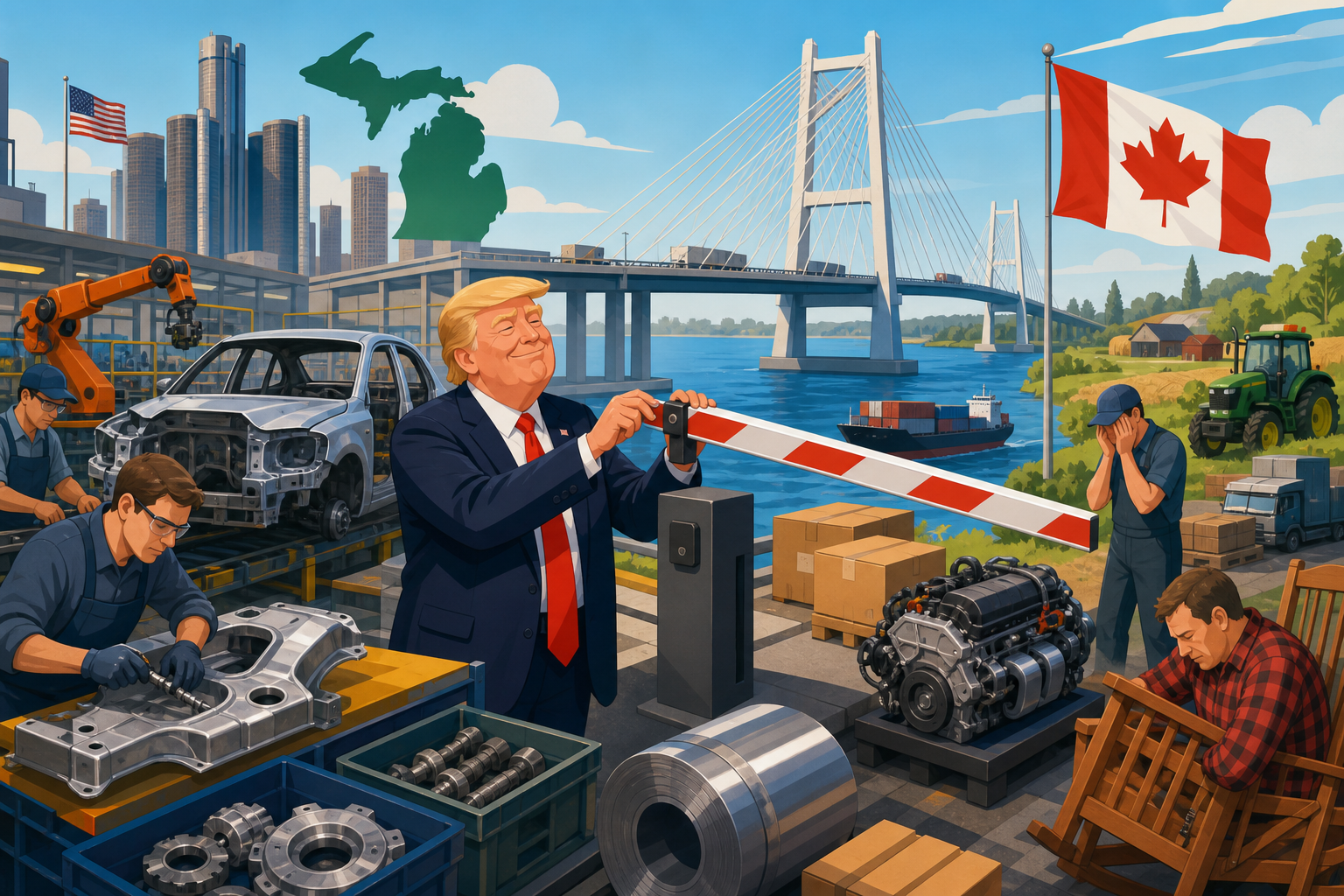

The Gordie Howe International Bridge opened to traffic in early 2026 with almost no ceremony, a $6 billion crossing that was supposed to symbolize North American integration now standing as a monument to its opposite. The physical infrastructure is complete. The political willingness to use it is not.
Canada remains Michigan's largest export market, absorbing roughly $80 billion in two-way trade annually. That trade supports hundreds of thousands of Michigan jobs, most of them concentrated in automotive manufacturing corridors where a single component might cross the Ambassador Bridge or the new Gordie Howe span seven times during assembly. Each crossing now carries a tariff. The cumulative effect is not marginal, industry analysts estimate production costs per vehicle could rise by more than $2,500 if the administration's proposed reciprocal tariffs are fully implemented.
The administration's position is straightforward: tariffs protect domestic steel and aluminum producers, industries flagged as national security priorities under Section 232. The current rate on certain imported steel sits at 25 percent, with Canadian aluminum facing a 10 percent baseline duty. These are not symbolic figures. They represent a direct tax on Michigan's tool-and-die shops, parts suppliers, and stamping facilities, the downstream users who consume imported raw materials and employ far more people than the primary metal producers the tariffs are designed to protect.
The Infrastructure Paradox
We are building faster highways to slow down commerce. The Gordie Howe Bridge was funded in part by the federal government, approved by both parties, and constructed to reduce bottlenecks at the Ambassador crossing. That engineering achievement now coexists with a regulatory regime that makes moving goods across it more expensive than it was five years ago. The bridge clears the physical path. The tariffs narrow the economic one.
This is not an accident of timing. The administration views tariffs as both a trade lever and a revenue stream, a way to offset domestic tax cuts while pressuring trading partners into bilateral concessions. Michigan is the testing ground for whether that theory holds when your largest customer is also your closest ally.
Who Actually Pays
Proponents argue that high tariffs are the only mechanism powerful enough to force automotive supply chains out of Asia and back into the Great Lakes region. That logic treats Canada as part of the problem rather than the solution, a confusion that costs Michigan workers twice: once when tariffs raise their input costs, and again when Canada retaliates by targeting Michigan-specific exports like agricultural products and furniture.
The downstream casualties outnumber the upstream beneficiaries by an order of magnitude. Primary metal production employs a few thousand Michigan workers. Automotive parts manufacturing employs more than 100,000. The tariff math does not work in their favor.
The United States-Mexico-Canada Agreement is up for its formal six-year review in 2026, a process the administration is using as leverage to extract concessions on dairy, digital services, and automotive rules of origin. That review was always going to create uncertainty. The tariff regime layered on top transforms uncertainty into measurable cost.
What Michigan Actually Needs
Michigan manufacturers are not asking for protection from Canada. They are asking for predictable access to it. The just-in-time supply chain that powers the state's automotive sector depends on goods crossing the border on the same day they are ordered, often multiple times before final assembly. Tariffs do not protect that system. They tax it.
The bridge is open. The question is whether the policy framework will allow it to function as designed, or whether the administration's preference for bilateral wins over multilateral stability will turn a $6 billion infrastructure investment into an underutilized symbol of what North American integration used to mean.
Read Next
Canada's Big Six banks hit $37.5 billion in impaired loans, triple pre-pandemic levels
Your 2.5% Mortgage Rate and Ontario Divorce: 7 Ways to Keep or Share It
Fixed Mortgage Rates Climb as Bond Yields Erase Discount Room
Manulife One at 4.95% vs. Five-Year Fixed at 3.94%: The Shrinking Cash Flow Advantage