Advanced mortgage strategies from a twenty-year strategist. Written to help you pay off sooner, save more, and retire three to four times wealthier — without paying more each month.
Trump's tariff threats aren't about trade, they're about disruption, and Canada should stop pretending otherwise
Trump's tariff threats aren't about trade, they're about disruption, and Canada should stop pretending otherwise
The daily value of goods crossing the Canada-U.S. border exceeds $3.5 billion. That number represents roughly 20% of Canada's GDP and the primary export market for 35 American states. It also represents the most lucrative poker chip Donald Trump has ever held, and he knows it.
For eighteen months, the pattern has been consistent: threaten universal baseline tariffs of 10% to 20%, float Section 232 national security provisions, demand concessions on unrelated files like NATO spending or dairy supply management, then recalibrate. The playbook is not about reducing trade barriers. It is about using the threat of barriers as a wedge to extract outcomes that have nothing to do with comparative advantage or market efficiency.
Canadian policymakers continue to respond as if this is a negotiation over trade terms. It isn't. It's a negotiation over leverage, and the sooner Ottawa stops treating it like a technical dispute inside the rules-based WTO framework, the better positioned Canada will be to navigate what's actually happening.
The shift from rules to power
Trade policy under the Trump administration, both during his first term and the current cycle, represents a structural departure from the post-1945 multilateral order. The objective is not freer trade. It is managed trade, where outcomes like the bilateral trade deficit are predetermined targets regardless of whether they reflect underlying economic efficiency.
CUSMA, the trade agreement that replaced NAFTA in 2020, includes a joint review clause scheduled for July 2026. That review was designed as a stability mechanism. In practice, it has become a hammer: the implicit threat that the U.S. could signal withdrawal if Canada does not bend on issues far beyond tariffs. The agreement was supposed to lock in predictability. Instead, it created a ticking clock.
Section 232 of the Trade Expansion Act, originally intended for genuine national security concerns, has been repurposed as an all-purpose tariff tool. Steel, aluminum, and now potentially automotive and energy imports have all been framed as security risks, bypassing the need for congressional approval or WTO compliance. The legal mechanism is just packaging. The real mechanism is the credible threat of unilateral market closure.
Why "keep calm" is the only viable path
Retaliation feels decisive, but it accelerates exactly the outcome Canada should avoid: decoupling. In 2018, when Trump imposed steel and aluminum tariffs citing Section 232, Canada responded with proportional, reciprocal tariffs targeting politically sensitive districts in swing states. The strategy worked because it aligned Canadian interests with U.S. industry coalitions who needed the border open more than they needed the tariffs.
That playbook still applies. The integrated supply chain in automotive and aerospace means a single component crosses the Canada-U.S. border up to seven times during production. A universal tariff regime does not punish Canada in isolation. It raises input costs for American manufacturers, fuels domestic inflation, and alienates the very governors and business leaders whose states depend on Canada as their largest export market.
Provincial diplomacy matters more now than federal grandstanding. Ontario exports more to Michigan than Michigan exports to China. Quebec supplies Vermont and New York with electricity they cannot easily replace. Alberta oil flows to refineries in the Midwest that are optimized for Canadian heavy crude and cannot pivot to alternative sources without multibillion-dollar infrastructure investments.
The energy file, specifically, functions as Canada's insurance policy. The U.S. imports more oil from Canada than from any other country. Tariffs on energy drive up gasoline prices domestically, a political cost Trump's team understands perfectly well.
What disruption actually looks like
Treating this as a conventional trade dispute misreads the incentive structure. Trump's trade policy is not about optimizing market access. It is about creating the appearance of toughness and delivering symbolic wins to a domestic base that views trade surpluses in partner countries as theft. The goal is disruption itself, and the willingness to absorb short-term economic pain to force concessions.
Canada cannot out-disrupt the United States. It can, however, make disruption expensive enough that specific American industries apply counterpressure. The 2018 tariff fight ended not because Canada escalated rhetorically, but because U.S. steel users and auto manufacturers lobbied Congress to stop the bleeding.
Calm is not passivity. It is strategic patience. Stay aligned with U.S. business interests, avoid giving Trump a domestic villain to rally against, and let the integrated nature of the North American economy do the work. The border is not a wall. It is a wound that bleeds in both directions.


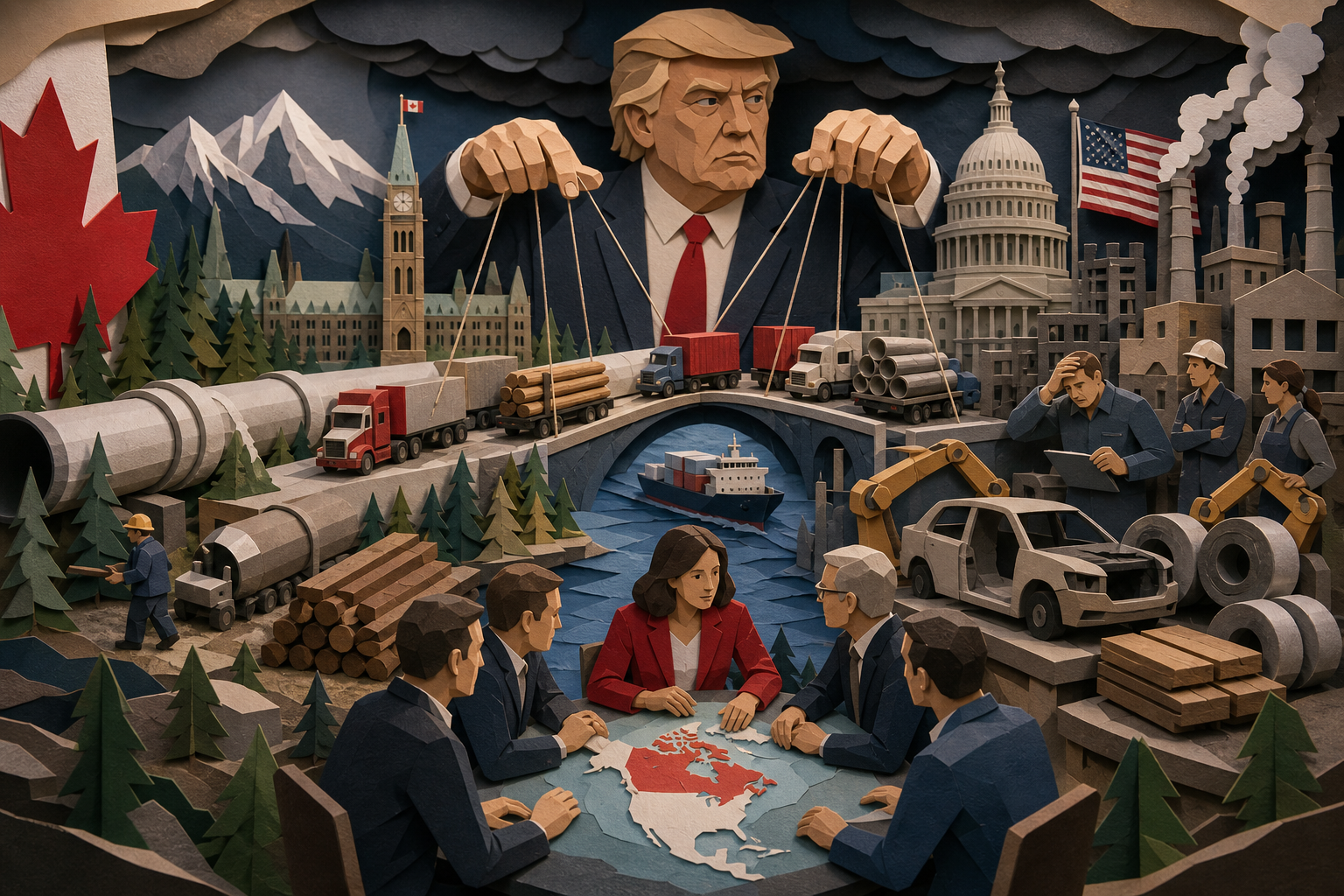

Trump's tariff threats aren't about trade, they're about disruption, and Canada should stop pretending otherwise
The daily value of goods crossing the Canada-U.S. border exceeds $3.5 billion. That number represents roughly 20% of Canada's GDP and the primary export market for 35 American states. It also represents the most lucrative poker chip Donald Trump has ever held, and he knows it.
For eighteen months, the pattern has been consistent: threaten universal baseline tariffs of 10% to 20%, float Section 232 national security provisions, demand concessions on unrelated files like NATO spending or dairy supply management, then recalibrate. The playbook is not about reducing trade barriers. It is about using the threat of barriers as a wedge to extract outcomes that have nothing to do with comparative advantage or market efficiency.
Canadian policymakers continue to respond as if this is a negotiation over trade terms. It isn't. It's a negotiation over leverage, and the sooner Ottawa stops treating it like a technical dispute inside the rules-based WTO framework, the better positioned Canada will be to navigate what's actually happening.
The shift from rules to power
Trade policy under the Trump administration, both during his first term and the current cycle, represents a structural departure from the post-1945 multilateral order. The objective is not freer trade. It is managed trade, where outcomes like the bilateral trade deficit are predetermined targets regardless of whether they reflect underlying economic efficiency.
CUSMA, the trade agreement that replaced NAFTA in 2020, includes a joint review clause scheduled for July 2026. That review was designed as a stability mechanism. In practice, it has become a hammer: the implicit threat that the U.S. could signal withdrawal if Canada does not bend on issues far beyond tariffs. The agreement was supposed to lock in predictability. Instead, it created a ticking clock.
Section 232 of the Trade Expansion Act, originally intended for genuine national security concerns, has been repurposed as an all-purpose tariff tool. Steel, aluminum, and now potentially automotive and energy imports have all been framed as security risks, bypassing the need for congressional approval or WTO compliance. The legal mechanism is just packaging. The real mechanism is the credible threat of unilateral market closure.
Why "keep calm" is the only viable path
Retaliation feels decisive, but it accelerates exactly the outcome Canada should avoid: decoupling. In 2018, when Trump imposed steel and aluminum tariffs citing Section 232, Canada responded with proportional, reciprocal tariffs targeting politically sensitive districts in swing states. The strategy worked because it aligned Canadian interests with U.S. industry coalitions who needed the border open more than they needed the tariffs.
That playbook still applies. The integrated supply chain in automotive and aerospace means a single component crosses the Canada-U.S. border up to seven times during production. A universal tariff regime does not punish Canada in isolation. It raises input costs for American manufacturers, fuels domestic inflation, and alienates the very governors and business leaders whose states depend on Canada as their largest export market.
Provincial diplomacy matters more now than federal grandstanding. Ontario exports more to Michigan than Michigan exports to China. Quebec supplies Vermont and New York with electricity they cannot easily replace. Alberta oil flows to refineries in the Midwest that are optimized for Canadian heavy crude and cannot pivot to alternative sources without multibillion-dollar infrastructure investments.
The energy file, specifically, functions as Canada's insurance policy. The U.S. imports more oil from Canada than from any other country. Tariffs on energy drive up gasoline prices domestically, a political cost Trump's team understands perfectly well.
What disruption actually looks like
Treating this as a conventional trade dispute misreads the incentive structure. Trump's trade policy is not about optimizing market access. It is about creating the appearance of toughness and delivering symbolic wins to a domestic base that views trade surpluses in partner countries as theft. The goal is disruption itself, and the willingness to absorb short-term economic pain to force concessions.
Canada cannot out-disrupt the United States. It can, however, make disruption expensive enough that specific American industries apply counterpressure. The 2018 tariff fight ended not because Canada escalated rhetorically, but because U.S. steel users and auto manufacturers lobbied Congress to stop the bleeding.
Calm is not passivity. It is strategic patience. Stay aligned with U.S. business interests, avoid giving Trump a domestic villain to rally against, and let the integrated nature of the North American economy do the work. The border is not a wall. It is a wound that bleeds in both directions.
Read Next
Canada's Big Six banks hit $37.5 billion in impaired loans, triple pre-pandemic levels
Your 2.5% Mortgage Rate and Ontario Divorce: 7 Ways to Keep or Share It
Fixed Mortgage Rates Climb as Bond Yields Erase Discount Room
Manulife One at 4.95% vs. Five-Year Fixed at 3.94%: The Shrinking Cash Flow Advantage